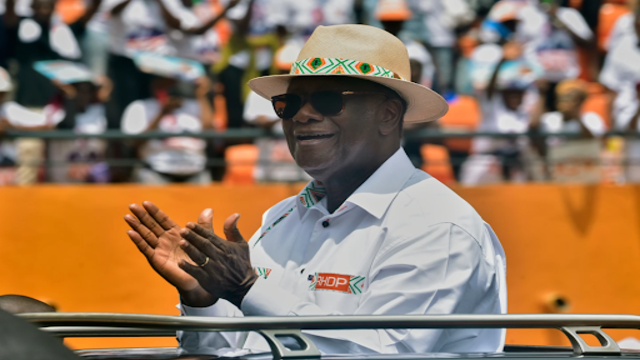
President Alssanne outtara arrives at a campign rally at a stadium in Abidjan. Associated Press
Placide Konan, a 33-year-old slam poet in Abidjan, uses his art to voice the growing anger among Ivory Coast’s youth. His words echo a nation’s frustration as 83-year-old President Alassane Ouattara seeks a controversial fourth term in Saturday’s election.
Despite Ivory Coast’s image as one of West Africa’s strongest economies, inequality and poverty continue to deepen. The country remains the world’s largest cocoa producer, yet 37.5% of Ivorians live below the poverty line. More than 75% of the population is under 35, struggling with unemployment and rising costs.
“People can no longer make ends meet,” Konan said. “You have to be lucky—or a magician—to live comfortably in Abidjan.”
A Contested Election
Ouattara, who has ruled since 2011, is widely expected to win again. Many prominent opposition figures have been sidelined, sparking claims of foul play.
Former Credit Suisse CEO Tidjane Thiam, one of the strongest challengers, was barred from running after a court ruled he held French nationality—disqualifying him under Ivorian law. Thiam called the decision politically motivated and renounced his French citizenship in March, but it was too late.
With Thiam out, Ouattara faces a weakened field, including former Commerce Minister Jean-Louis Billon and ex–First Lady Simone Gbagbo. Analysts say the election reflects a familiar pattern across Africa—aging leaders clinging to power amid growing youth discontent.
Fear of Violence Looms
About 8.7 million Ivorians are eligible to vote, but tensions are high. Protests have already erupted following opposition bans, with authorities responding harshly. Hundreds of demonstrators have been arrested, and at least three people have been killed.
The government has restricted public gatherings and deployed 40,000 security personnel to maintain order. Critics argue these measures suppress dissent and tilt the election in Ouattara’s favor.
“The recent events undermine stability at a time when Ivory Coast faces major regional and economic challenges,” said Paul Melly of Chatham House.
Memories of past unrest remain fresh. When Ouattara first came to power in 2011 after a disputed election, 3,000 people died in post-election violence.
Ouattara’s Justification
Ignoring calls to retire, Ouattara insists his continued leadership is needed to navigate “unprecedented security, economic, and monetary challenges.”
At a recent rally, he appealed to young voters, saying: “I have always worked to give our youth opportunities—to learn, work, and be independent.”
In 2020, Ouattara secured a third term after claiming that a 2016 constitutional amendment reset his term limits. Nearly 100 people died in protests that followed.
“Ouattara has near-total control of the state apparatus,” said Séverin Yao Kouamé, a political researcher at the University of Bouaké. “He has defeated or absorbed most of his rivals.”
Growth and Gaps
Supporters highlight the country’s infrastructure boom and steady economic growth. The World Bank reports Ivory Coast’s economy grew by 6% in 2024. Roads, railways, and urban projects are transforming the country.
“If you left Côte d’Ivoire for a few years, you’d barely recognize your neighborhood,” said Assita Karamoko, a hairdresser and Ouattara supporter in Abidjan.
Yet, despite visible progress, many say the benefits have not reached ordinary citizens. Youth unemployment remains high, and opportunities are scarce. “The growth is impressive on paper,” said Melly, “but translating it into real jobs for young people is still a huge challenge.”
Security Strains in the North
Ivory Coast’s northern border with Mali and Burkina Faso remains volatile. Armed groups have pushed southward, raising fears of regional instability.
Though Ivory Coast’s military is one of West Africa’s strongest, experts warn of growing pressure. “The security conditions are fragile in the north,” Melly noted. “It’s not the government’s fault—but it’s the reality of the region.”
A Nation at a Crossroads
As the election approaches, Ivory Coast stands divided. President Ouattara points to stability and growth as proof of his success. But for millions of young Ivorians like Konan, frustration runs deep.
They want change, opportunity, and a government that listens. Whether their voices will be heard in this election remains uncertain—but their anger is impossible to ignore.