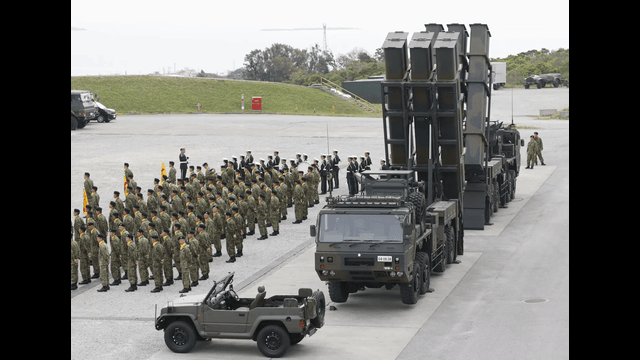
Type 12 surface-to-ship missiles launches are seen at the inauguration ceremony of a missile regiment of the Japan Ground Self-defense Force in Uruma, Okinawa, southern Japan, on March 30, 2024.
Japan has taken a major step to strengthen its military posture.
The Cabinet approved a record Japan defense budget exceeding 9 trillion yen for fiscal 2026.
The move reflects Tokyo’s growing concern over China’s military activity in the region.
It also signals Japan’s fastest defense expansion in decades.
The draft budget, starting in April, marks a 9.4% rise from the previous year.
It is the fourth year of a five-year plan to double defense spending.
Japan aims to reach 2% of its gross domestic product by March.
This target comes earlier than initially planned.
Prime Minister Sanae Takaichi’s government says the increase is essential.
Officials argue Japan must be ready for regional instability.
China’s posture toward Taiwan remains a central concern.
Japan defense budget reflects shifting security strategy
The current buildup breaks with Japan’s post-war military approach.
For decades, Japan limited force strictly to self-defense.
That stance is now changing.
Japan’s 2022 security strategy names China as its top strategic challenge.
It also supports stronger cooperation with the United States.
The latest Japan defense budget builds on that policy shift.
Takaichi stated last November that Japan could be drawn into a Taiwan crisis.
Beijing reacted sharply to the remarks.
Tensions have since increased between the two neighbors.
Missiles strengthen southwestern island defenses
A major share of the Japan defense budget focuses on missile capabilities.
More than 970 billion yen is set aside for “standoff” strike systems.
These weapons allow attacks from long distances.
Japan will spend 177 billion yen on upgraded Type-12 surface-to-ship missiles.
The missiles have a range of about 1,000 kilometers.
They are domestically developed and newly enhanced.
The first batch will be deployed in Kumamoto prefecture.
Deployment will happen a year earlier than scheduled.
The area lies close to Japan’s southwestern island chain.
Drones become key to coastal protection
Unmanned systems form another pillar of the new Japan defense budget.
Japan faces manpower shortages due to its aging population.
Officials see drones as a practical solution.
About 100 billion yen will fund unmanned air, sea, and underwater drones.
They will operate under a system called “SHIELD.”
The system is planned for deployment by March 2028.
These drones will focus on surveillance and coastal defense.
Japan may initially rely on foreign suppliers.
Turkey and Israel are among the possible partners.
Rising friction with China adds urgency
The budget decision comes amid heightened friction with China.
Japanese officials have raised concerns over Chinese naval drills.
Recent exercises took place near southwestern Japan.
Tokyo protested after Chinese aircraft locked radar onto Japanese planes.
Such actions are seen as potential missile preparation.
China denies any hostile intent.
Japan is also alarmed by China’s expanding Pacific operations.
Two Chinese aircraft carriers operated near Iwo Jima in June.
The event was unprecedented and closely watched in Tokyo.
In response, Japan will open a new defense research office.
It will focus on China’s Pacific strategy and capabilities.
Joint projects boost Japan’s defense industry
Japan is also strengthening its defense industry.
Recent reforms eased long-standing arms export restrictions.
The new Japan defense budget supports joint development projects.
More than 160 billion yen is earmarked for a next-generation fighter jet.
The project is shared with Britain and Italy.
Deployment is planned for 2035.
Japan is also developing AI-controlled drones to fly alongside the jet.
In August, Australia selected Mitsubishi Heavy Industries for frigate upgrades.
The deal marked a major export win for Japan.
Nearly 10 billion yen will support arms sales and industrial capacity.
Funding questions remain despite meeting targets
The defense plan requires parliamentary approval by March.
It forms part of a 122.3 trillion yen national budget.
If approved, Japan will meet its 2% GDP defense goal.
Annual defense spending could reach 10 trillion yen.
That would make Japan the world’s third-largest military spender.
Only the United States and China would spend more.
Funding remains a challenge.
The government plans tax increases on corporations, tobacco, and income.
Whether Japan can sustain higher spending beyond this target remains uncertain.