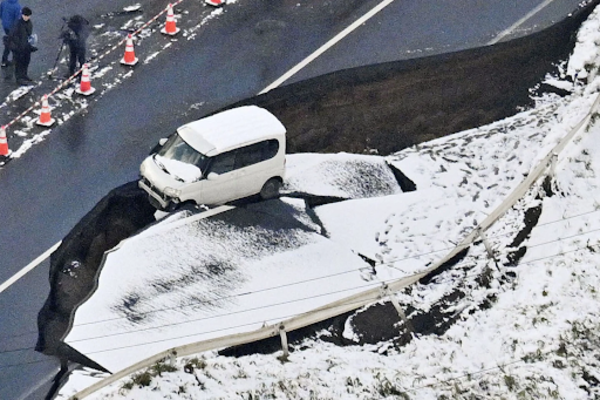
This aerial photo shows a vehicle sitting on a damaged road in Tohoku town, Aomori prefecture, northern Japan Tuesday, Dec. 9, 2025, following a powerful earthquake on late Monday. Associated Press
Japan is assessing widespread but mostly moderate damage after a 7.5 magnitude earthquake struck late Monday night off the coast of Aomori prefecture. The strong quake triggered a small tsunami, caused injuries, disrupted transport, and left hundreds without power. Authorities continue to warn residents about potential aftershocks in the coming days.
Injuries and Immediate Impact
The Fire and Disaster Management Agency confirmed at least 33 injuries, including one serious case. Most injuries were caused by falling objects inside homes and public spaces, NHK reported.
Prime Minister Sanae Takaichi said an emergency task force has been activated to assess damage and coordinate safety measures. She emphasized that the government is “putting people’s lives first” as teams work through affected areas.
Earthquake and Tsunami Details
The quake struck at 11:15 p.m., about 80 kilometers off Aomori’s coast, and was measured at 7.6 magnitude by the U.S. Geological Survey. The epicenter was located 44 kilometers below the ocean surface.
The Japan Meteorological Agency (JMA) recorded a tsunami of 70 centimeters in Kuji port, Iwate prefecture. Other coastal towns reported waves up to 50 centimeters. Some oyster rafts were damaged, though no major flooding occurred. Tsunami advisories were fully lifted by 6:30 a.m. Tuesday.
Power Cuts and Transport Disruptions
Chief Cabinet Secretary Minoru Kihara reported that about 800 homes initially lost power. Most electricity was restored by morning, according to Tohoku Electric Power Co.
The earthquake halted Shinkansen bullet trains and several local rail lines for safety inspections. East Japan Railway aims to restore full bullet train service later Tuesday.
About 200 passengers were stranded overnight at New Chitose Airport in Hokkaido after ceiling panels fell inside a terminal. A portion of the building remained closed for repairs.
Government and Defense Response
Around 480 residents took shelter at Hachinohe Air Base, where the Defense Ministry deployed 18 helicopters for aerial damage assessments, Defense Minister Shinjiro Koizumi said.
The Nuclear Regulation Authority (NRA) reported that roughly 450 liters of water spilled from a spent fuel cooling pool at the Rokkasho reprocessing plant. Officials assured the public that the water level remained stable and there were no safety risks. No other nuclear facilities showed abnormalities.
Aftershocks and Future Risks
The JMA warned of continuing aftershocks and noted a slight increase in the possibility of a magnitude 8 quake along Japan’s northeastern coast—stretching from Chiba to Hokkaido. The agency urged residents in 182 municipalities to review emergency plans, stressing that this advisory is not a prediction of a major quake but a preparedness reminder.
The region sits just north of the zone hit by the 2011 magnitude 9.0 earthquake and tsunami, which killed nearly 20,000 people and triggered the Fukushima Daiichi nuclear disaster.
“You need to prepare, assuming that a disaster like that could happen again,” JMA official Satoshi Harada said.
Aftershocks continued Tuesday, including a 6.6 and later a 5.1 quake, according to the USGS.
A Nation Focused on Preparedness
Japan continues to prioritize rapid assessments and community safety. Emergency response teams, rail operators, and local governments are working to restore normal operations while preparing for potential aftershocks.
The earthquake served as another reminder of Japan’s vulnerability along major fault lines and its commitment to maintaining strong disaster protocols.