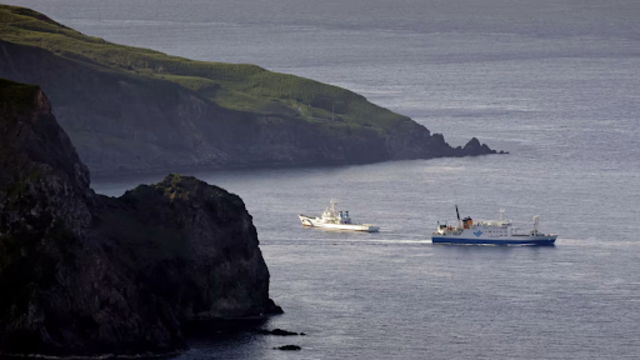
A ferry carrying evacuating residents and visitors sails out of Akuseki Island in southwestern Japan on Saturday.
Japan is experiencing a surge in seismic activity, with over 1,000 tremors shaking the Kagoshima region in the past two weeks. After a 5.5-magnitude earthquake struck the waters off Kyushu’s southern tip on Thursday, authorities issued fresh warnings on Saturday, cautioning about the possibility of more strong quakes in the region.
Despite these concerns, officials have urged the public to remain calm and not fall for baseless predictions about a looming catastrophe. Recent earthquake rumors have gone viral, largely fueled by an old manga series some believe foretold a major disaster this month.
Kagoshima Quakes Trigger Precautionary Evacuations
The tremors have been concentrated in Japan’s remote southwestern islands, particularly around Kagoshima Prefecture. Thursday’s quake was strong enough to make it difficult to stand, prompting authorities to evacuate several residents from vulnerable areas.
Just a day later, another 5.4-magnitude earthquake rocked the same region. While no major damage has been reported so far, the frequency and intensity of the tremors have raised public anxiety.
Scientists Say Predictions Are Impossible
Amid the growing unease, Japan’s Meteorological Agency has stepped in to address misinformation. Ayataka Ebita, head of the agency’s earthquake and tsunami division, emphasized that no one can predict the exact time or scale of a future earthquake.
“With our current scientific knowledge, it’s difficult to predict the exact time, place, or scale of an earthquake,” Ebita said during a press briefing. “We ask that people base their understanding on scientific evidence.”
Comic Book Sparks Unwarranted Fears
The source of much of the current panic is a comic book—The Future I Saw—originally published in 1999 and re-released in 2021. The manga, created by artist Ryo Tatsuki, contains illustrations that some readers believe foretold a large-scale disaster in June 2025.
As the date mentioned in the comic approached, social media buzz and speculation increased, especially in Hong Kong. This, in turn, affected Japan’s tourism sector. Data from Japan’s tourism board show that visitor arrivals from Hong Kong dropped by 11% in May compared to last year.
In response to the rising panic, Tatsuki’s publisher issued a statement clarifying that the artist does not claim to have any prophetic abilities. “I am not a prophet,” Tatsuki said in the release, distancing herself from the predictions circulating online.
Japan Remains a Popular Tourist Destination
Despite these unfounded fears, Japan continues to be a leading destination for global travelers. In fact, the country hit a new monthly record for tourist arrivals in April, welcoming 3.9 million visitors.
While a temporary dip in numbers has been recorded due to the quake rumors, officials are optimistic that confidence will return as facts replace fiction.
Earthquakes in Japan: A Constant Reality
Japan is located in one of the most seismically active zones in the world. The country experiences around 20% of all earthquakes measuring 6.0 or higher. Given this, minor and moderate quakes are part of life in Japan, and its infrastructure is designed to handle them.
However, misinformation can often cause more panic than the earthquakes themselves. The current episode underscores the importance of trusting official sources and scientific data rather than social media speculation or fictional narratives.
As tremors continue in the southwestern region, authorities remain vigilant. Their message to the public is clear: be alert, not alarmed.