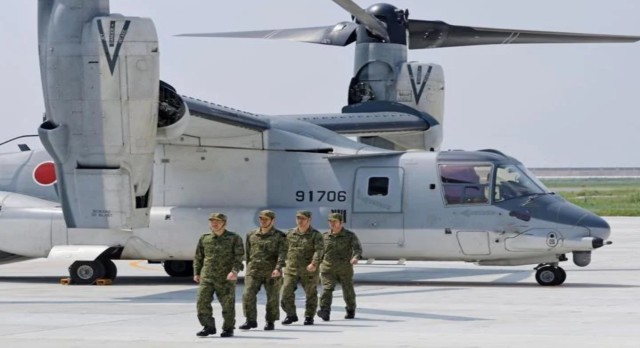
Members of Japan Ground Self-Defense Force disembark from a V-22 Osprey on arrival at Camp Saga, southwestern Japan, July 9, 2025. (AP Photo)
Japan has officially begun deploying its V-22 Osprey aircraft fleet to a newly completed base in the southwest, reinforcing its military posture amid rising regional tensions.
On Wednesday, the first of 17 tilt-rotor Ospreys touched down at Camp Saga, located in Saga Prefecture. This move signals the beginning of a full-scale transition from their previous temporary home near Tokyo. According to Japan’s Ground Self-Defense Force (JGSDF), the rest of the aircraft will arrive by mid-August.
The timing is no coincidence. Tensions in the region have been climbing steadily, especially with China expanding its maritime activity around Japan’s remote southwestern islands. Officials say this Osprey deployment is a critical part of Japan’s broader strategy to protect its territory and maintain stability in the region.
Why Camp Saga?
Camp Saga isn’t just a new facility—it’s a tactical choice.
The base lies close to key naval and air units, including the amphibious rapid deployment brigade in Ainoura, Sasebo. This allows for swift joint operations in case of emergencies, particularly on Japan’s scattered southern islands. It also neighbors Camp Metabaru, where 50 helicopters are already stationed, creating a tight-knit hub of ground and air mobility.
“The security environment surrounding Japan has become more severe,” Defense Minister Gen Nakatani said Tuesday.
“Strengthening our island defense capabilities is now an urgent task.”
By relocating the Ospreys to Saga, Japan ensures these high-speed, long-range aircraft are closer to potential flashpoints and better positioned for rapid response.
Still a Controversial Aircraft
While the deployment is being seen as a strategic win, public sentiment around the Osprey remains mixed.
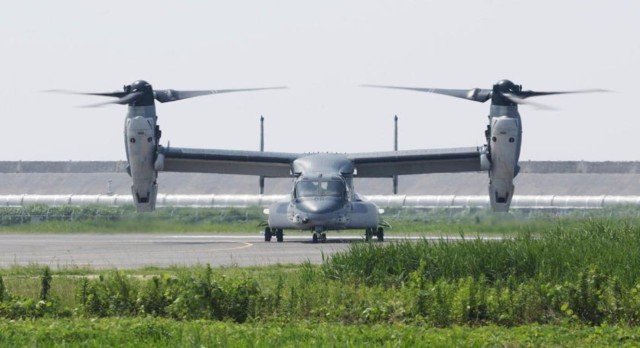
The aircraft’s unique ability to take off like a helicopter and fly like a plane makes it ideal for island defense—but it hasn’t been without problems. In November 2023, a U.S. Air Force Osprey crashed off Japan’s southern coast, killing eight. A year later, a Japanese Osprey tilted and hit the ground during a joint training drill. Human error was cited in that case.
These incidents have raised safety concerns, especially in areas like Okinawa where U.S. military presence is already a sensitive topic. But despite protests and ongoing concerns, Japan’s defense planners continue to see the Osprey as a vital tool for fast-response missions.
A Bigger Picture Ahead
This deployment is just one piece of Japan’s larger defense overhaul.
In recent years, the government has steadily expanded its military reach in the southwest, launching new units, upgrading bases, and enhancing interoperability with U.S. forces. The Ospreys will likely play a central role in that ongoing effort—bridging land and sea in regions where mobility can mean the difference between security and vulnerability.
As the rest of the Osprey fleet joins Camp Saga in the coming weeks, one thing is clear: Japan is no longer taking a backseat in the Indo-Pacific. It’s preparing for whatever comes next.