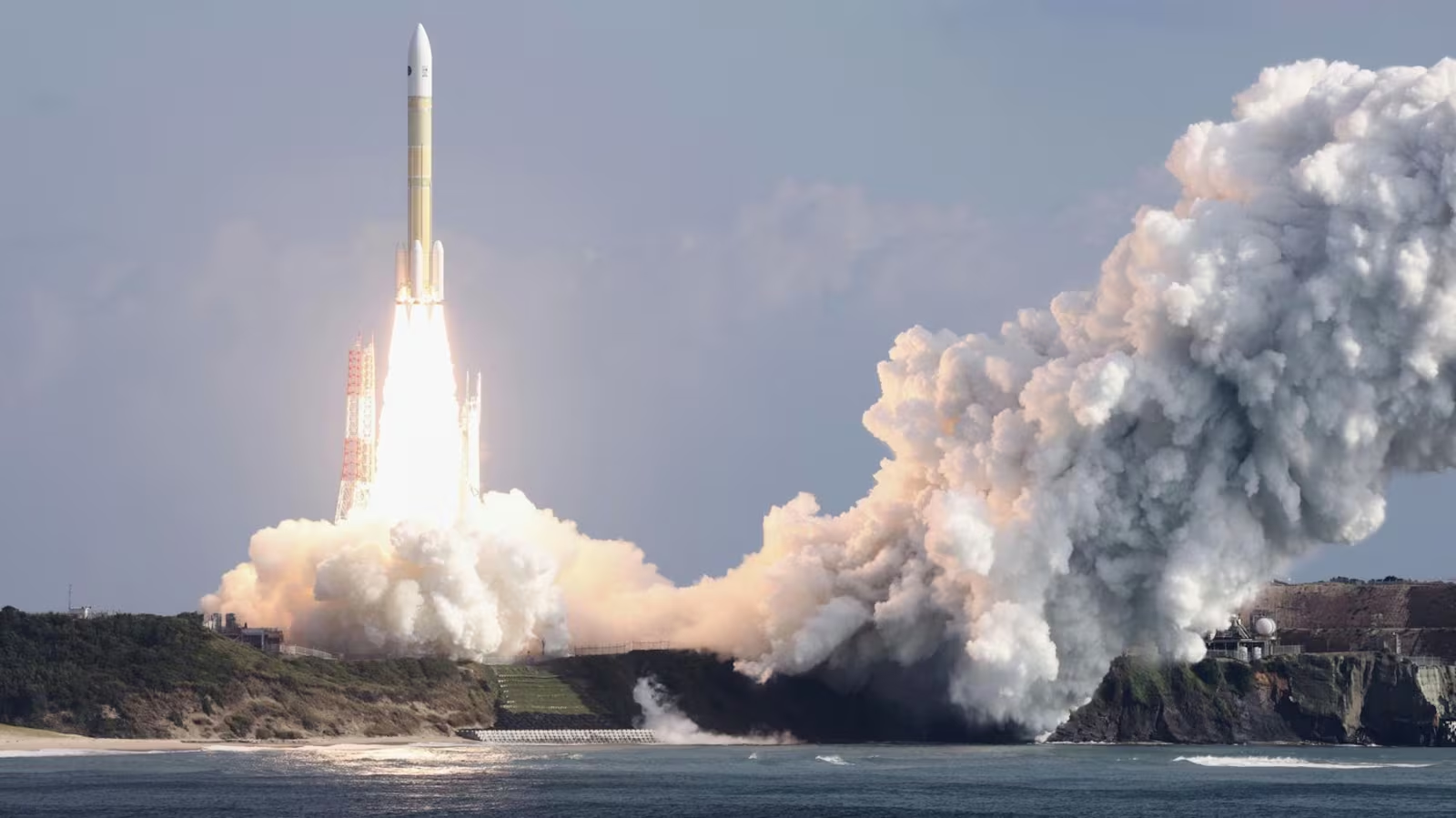
Japan’s H3 rocket, carrying the new HTV-X cargo spacecraft, soars into the sky after lifting off from the Tanegashima Space Center on Tanegashima Island in southern Japan on Sunday, Oct. 26, 2025. (Photo: AP)
Japan’s space program reached a major milestone on Sunday when its most powerful rocket, the H3, successfully launched an unmanned cargo spacecraft on its first mission to deliver supplies to the International Space Station (ISS).
The Japan Aerospace Exploration Agency (JAXA) confirmed that the HTV-X1 spacecraft lifted off from the Tanegashima Space Center in southern Japan atop the No. 7 H3 rocket. Fourteen minutes later, it entered its intended orbit, marking a flawless start to the mission.
If everything goes according to plan, the HTV-X1 will arrive at the ISS within a few days. Japanese astronaut Kimiya Yui, who is currently aboard the station, will capture the spacecraft using a robotic arm early Thursday morning.
A stronger, smarter supply ship
The HTV-X1 is the latest generation of Japan’s cargo spacecraft, succeeding the H-II Transfer Vehicle, known as Kounotori (meaning “stork”). The earlier model completed nine successful supply runs between 2009 and 2020.
The new HTV-X can carry heavier loads and includes new systems that allow it to power and transport sensitive lab materials that need to stay cold. It can remain docked at the ISS for up to six months, delivering supplies and bringing back waste.
After detaching from the station, the spacecraft will continue to orbit Earth for three months, conducting technical experiments before re-entering the atmosphere.
H3 rocket’s powerful upgrade
Sunday’s launch was also the first flight for the most powerful version of Japan’s H3 rocket. This upgraded model features four boosters and a larger payload fairing, allowing it to carry bigger and heavier cargo into space.
JAXA President Hiroshi Yamakawa praised the success, calling it “a major step forward” for Japan’s space program. He said the achievement proves Japan’s ability to deliver essential supplies to orbit, forming “the basis of autonomous space activity.”
Iwao Igarashi, who leads the Space Business Department at Mitsubishi Heavy Industries, the company that developed and operates the rocket with JAXA, said the success strengthens Japan’s reputation for reliability and precision. “The H3’s performance and flexibility show we can meet a wide range of customer needs,” he said, adding that Mitsubishi plans to expand its launch operations in the near future.
Looking ahead in space competition
The H3 rocket replaces Japan’s long-serving H-2A model, which completed its final mission in June. The new rocket is built to be more efficient and affordable, allowing Japan to compete more effectively in the global space industry.
After a failed debut in 2023, when the rocket had to be destroyed mid-flight, the H3 has since completed six successful missions. Its reliability now positions Japan as an increasingly important player in space logistics and research.
Japan considers maintaining a stable and independent space transport system essential for both its scientific goals and national security interests.