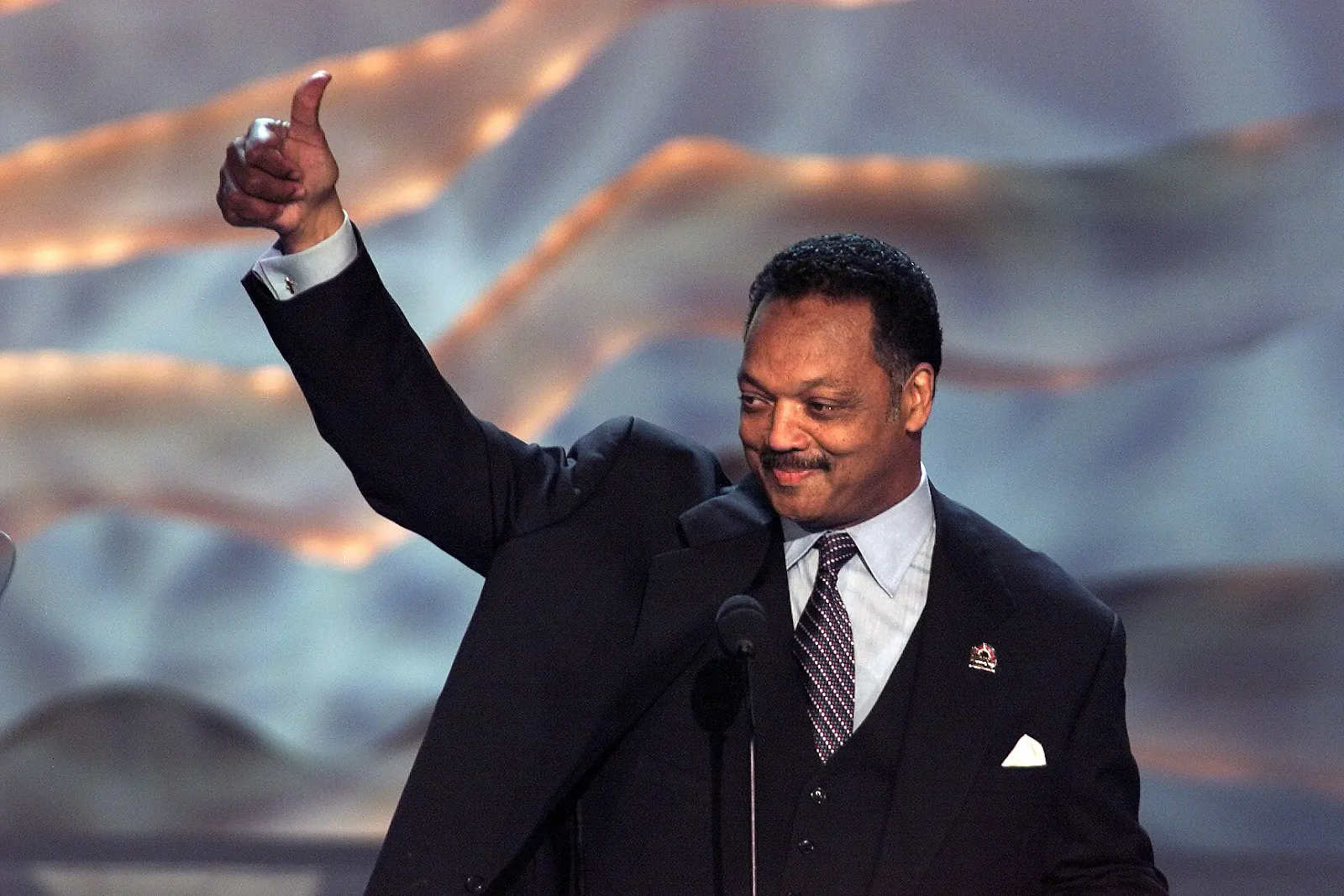
The Rev. Jesse Jackson responded to the crowd’s applause as delegates cheered during the 2000 Democratic National Convention in Los Angeles. The New York Times
The Rev. Jesse Jackson, a powerful voice for civil rights and social justice in the decades following the assassination of the Rev. Dr. Martin Luther King Jr., died Tuesday at his home in Chicago. He was 84.
His family confirmed his passing in a statement, saying he “died peacefully,” but did not disclose a cause of death.
Mr. Jackson faced serious health challenges in recent years. He announced in 2017 that he had Parkinson’s disease. In November, he entered hospital for treatment related to progressive supranuclear palsy, a rare neurological condition that affects movement and speech.
From Civil Rights to National Politics
After Dr. King’s assassination in 1968, Mr. Jackson stepped forward as one of the most visible Black leaders in the United States. Although he never reached the same moral stature as Dr. King or achieved the presidency as Barack Obama later would, he remained a major political and social force for decades.
Through passionate speeches and tireless campaigning, Mr. Jackson promoted what he called a “rainbow coalition,” a movement that aimed to unite people from different racial and economic backgrounds around common goals. He spoke often about dignity, opportunity and fairness for those who felt left behind.
At the 1984 Democratic National Convention, he declared, “My constituency is the desperate, the damned, the disinherited, the disrespected and the despised. They are restless and seek relief.” His speeches at party conventions in 1984 and 1988 energized supporters and shaped the direction of progressive politics at the time.
He ran for president twice, first in 1984 and again in 1988. In 1988, he won nearly seven million votes in the primaries and finished second in several contests. Although he did not secure the nomination, his campaign expanded political participation among Black voters and other marginalized groups.
Early Life and Awakening
Born Jesse Louis Burns on Oct. 8, 1941, in Greenville, South Carolina, Mr. Jackson grew up in a segregated community. His early years were marked by hardship and personal struggle. He later spoke openly about the challenges he faced as a child in the Jim Crow South.
After high school, he attended the University of Illinois on a football scholarship but later transferred to North Carolina Agricultural and Technical State University. There, he became active in student leadership and the civil rights movement.
In 1963, he led protests in Greensboro, North Carolina, and was arrested during demonstrations. Soon after, he met Dr. King and joined the Southern Christian Leadership Conference. By his mid-20s, he headed Operation Breadbasket in Chicago, which pushed businesses to hire Black workers and support Black-owned companies.
Controversy and Determination
Mr. Jackson’s career included moments of controversy. Some civil rights leaders criticized him after Dr. King’s assassination, questioning aspects of his public statements about that day. Over time, he faced political setbacks and personal controversies, including a public apology in 2001 after revelations that he had fathered a child outside his marriage.
Despite criticism, he remained active in public life. He advocated for voting rights, economic equality and global humanitarian causes. Presidents appointed him to diplomatic roles, and he received the Presidential Medal of Freedom in 2000.
In later years, he continued to speak at rallies and protest events. Even after health issues limited his mobility, he remained engaged in national debates about justice and equality.
A Lasting Influence
Historians often describe Mr. Jackson as a bridge between the civil rights era and modern Black political leadership. He helped expand voter participation and laid groundwork that many believe made future milestones possible.
“My mission has been to transform the mind of America,” he once said. “It’s not just politics — small p — as in delegates and votes. But politics — big P — as in transforming our minds and changing our self-concept.”
Mr. Jackson leaves behind his wife, Jacqueline, five children and several grandchildren.
Though he never achieved all the goals he set for himself, his voice echoed across generations. His call to “Keep hope alive” remains one of the most recognizable phrases in modern American political history.