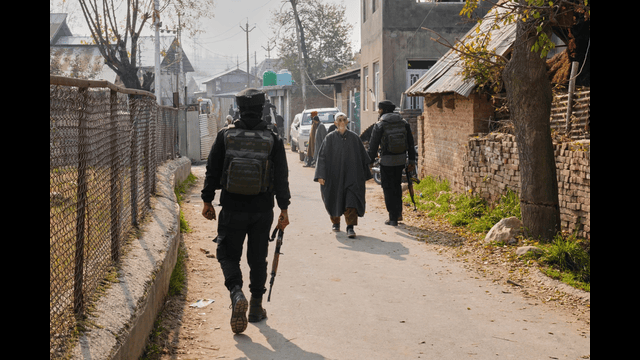
Indian Army soldiers patrol near the blown-up home of one of the suspects in the Delhi car blast.
Hours after police in Indian-controlled Kashmir released shopkeeper Bilal Ahmed Wani, the 55-year-old reportedly set himself on fire. His family said the worsening crackdown in Kashmir, triggered by the deadly New Delhi blast, had pushed him into despair.
Wani died a day later. Police described his death as a case of “self-inflicted burn injuries,” but relatives insisted humiliation and repeated detentions broke him emotionally.
The November 10 blast near New Delhi’s historic Red Fort killed at least 10 people and injured 32 others, prompting authorities to launch one of the harshest security crackdowns in Kashmir in recent years.
New Delhi Blast Sparks Wider Crackdown in Kashmir
Investigators quickly linked the explosion to possible militant activity in Kashmir. Security forces launched widespread raids, detained hundreds and questioned thousands. Officials described the bombing as a “heinous terror act,” intensifying pressure on the region.
The sweeping operation began just hours after police said they had dismantled a suspected militant cell stretching from Kashmir to New Delhi’s outskirts. Officers arrested at least seven people, including two Kashmiri doctors, and seized large quantities of explosives in Faridabad.
But the pressure deepened when part of the seized material detonated inside a Srinagar police station on November 14. The blast killed nine people. Kashmir’s police chief, Nalin Prabhat, ruled out sabotage, saying mishandling likely caused the fatal explosion.
Family Says Crackdown Drove Wani to Suicide
The intensified crackdown in Kashmir led to multiple detentions in Wani’s family. His eldest son, student Jasir Bilal Wani, was taken into custody on November 14. The next day, police detained Wani himself, along with his younger son and his brother, a physics lecturer.
Wani and the younger son were released the same evening. His brother was freed only after Wani died.
Relatives said the men were innocent and framed as convenient suspects. They said Wani returned home in a distressed state and barely spoke. The following morning, he stepped outside, poured gasoline over himself, and set his body ablaze.
Doctors at multiple hospitals attempted to save him, but he succumbed to severe burns in Srinagar.
Several residents said they had witnessed earlier waves of mass arrests. But many described the current crackdown in Kashmir as the harshest since 2019, when India revoked the region’s special autonomous status.
Medical Community on Edge
Investigators said the car used in the New Delhi blast belonged to a Kashmiri man. They identified the suspected suicide bomber as Umar Un Nabi, a doctor from Pulwama. Security forces later demolished his family home, a practice used before against families of alleged militants.
The National Investigation Agency accused Wani’s eldest son of working with the bomber and helping modify drones and build rockets. He remains in custody.
Authorities also launched a deeper probe into what they called a “white-collar terror ecosystem.” The scrutiny has focused on Kashmiri doctors, students, and professionals. Several doctors described the questioning as invasive and unlike anything seen before.
Experts Warn of Deepening Anger in Kashmir
Former intelligence officer Avinash Mohananey said the arrests show that educated youth are increasingly involved in anti-India sentiment. He said this reflects long-standing “anger beneath the surface” and a belief that Kashmiris remain politically powerless and ignored.
Kashmir has witnessed armed rebellion since 1989. India calls it Pakistan-backed terrorism. Pakistan denies the charge, and many Kashmiris see it as a struggle for freedom.
Analyst Praveen Donthi of the International Crisis Group said anger has grown sharply since India revoked Kashmir’s semi-autonomy in 2019. He said the latest crackdown in Kashmir is worsening fear, alienation and resentment.
He warned that such aggressive measures could fuel, rather than reduce, militancy.
“A moderate approach by New Delhi would be far more effective,” Donthi said. “The present crackdown risks triggering yet another cycle of violence.”