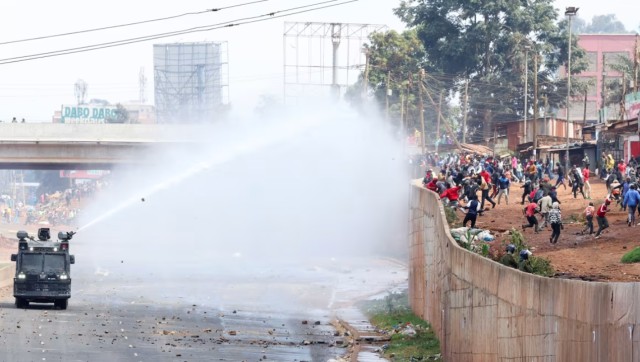
Police use water cannon to disperse protesters during anti-government protests dubbed "Saba Saba People's March," in the Kangemi area of Nairobi on July 7, 2025.
Kenya witnessed fresh waves of chaos on Monday as police used tear gas and water cannons against demonstrators across the country. The protests marked the anniversary of the historic Saba Saba rally but quickly turned into a violent expression of growing public frustration.
Saba Saba Anniversary Turns Turbulent
The July 7 protests began as a symbolic commemoration of the 1990 pro-democracy march known as Saba Saba. However, this year's gatherings soon reflected deeper grievances. Many Kenyans are fed up with economic hardship, government corruption, and increasing police brutality.
In Nairobi, the nation’s capital, security forces clashed with protestors early in the day. Police had already blocked several key roads leading into the city. Barricades were placed around major government institutions including Parliament and the president’s residence.
Despite these measures, crowds gathered. Soon after, clouds of tear gas filled the air, and water cannons were used to disperse demonstrators. Chaos unfolded in several neighborhoods.
Reports of Fatal Police Shootings Surface
By afternoon, unconfirmed reports began emerging about police using live ammunition. CNN could not verify these claims, but local media offered grim details.
Citizen TV reported that two individuals were shot dead in Nairobi’s Kangemi neighborhood. Another man, also reportedly shot, was seen unconscious and lying on the road.
Still, many protesters remained firm in their resolve. “We are not ready to go back home,” said Francis Waswa, a protester in Nairobi. “Who will fight for our rights then? We will be here till evening.”
Brutality Adds Fuel to the Fire
Public anger has been simmering for months. It began with last year’s controversial finance bill, which proposed new taxes despite the country’s deepening cost-of-living crisis. While the bill was eventually withdrawn, unrest continued.
Recent incidents have reignited public outrage. These include the death of a teacher in police custody and the killing of an unarmed vendor by police. Last month alone, at least 16 people died during protests. Throughout 2024, anti-tax demonstrations have claimed dozens more lives.
NGOs Targeted Amid Protests
Tensions rose further when unknown assailants stormed the offices of the Kenyan Human Rights Commission (KHRC) on Sunday. The NGO blamed “state-sponsored goons” for the attack, claiming they disrupted a press briefing led by mothers protesting enforced disappearances and extrajudicial killings.
“These individuals violently disrupted a press conference calling for justice,” said KHRC in a statement.
When CNN asked government spokesperson Isaac Mwaura for comment, he redirected inquiries to the police. Police spokesman Muchiri Nyaga later responded, saying the incident is under review. He added, “The National Police Service is looking into the incident and shall take appropriate steps after reviewing the unacceptable clip,” referring to CCTV footage of the attack.
Government’s Hardline Stance Sparks Backlash
Interior Minister Kipchumba Murkomen added fuel to the fire. A day before the protests, he warned that authorities were on high alert. He accused certain groups of planning to use the demonstrations as a cover for violence and disorder.
His earlier comments, describing last month’s protests as “terrorism disguised as dissent,” have only deepened public frustration.
A Nation on Edge
Kenya’s protest movement has evolved beyond economic demands. It now stands as a reflection of nationwide anger toward state repression, human rights abuses, and a political class perceived as indifferent to the suffering of ordinary citizens.
As more demonstrations are expected in the coming days, the spotlight will remain on how the Kenyan government and its police respond—and whether a peaceful resolution is still within reach.