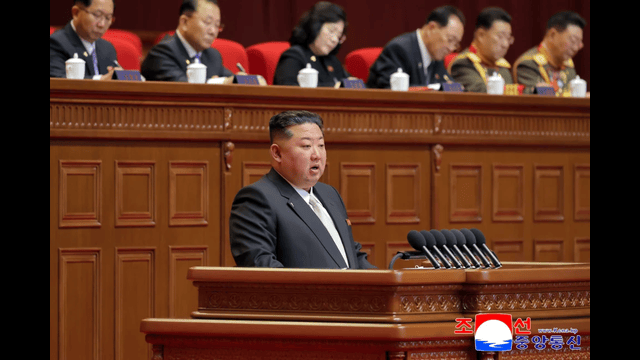
This photo provided on Friday, Feb. 20, 2026, by the North Korean government, North Korean leader Kim Jong Un delivers a speech during the ruling Workers’ Party Congress in Pyongyang, Thursday, Feb. 19, 2026. Independent journalists were not given access to cover the event depicted in this image distributed by the North Korean government. The content of this image is as provided and cannot be independently verified. Korean language watermark on image as provided by source reads: “KCNA” which is the abbreviation for Korean Central News Agency
North Korean leader Kim Jong Un opened a major ruling party congress with strong praise for national progress.
The gathering in Pyongyang is expected to shape domestic and foreign policy for five years.
Observers say the Kim Jong Un party congress could reinforce his authority and outline future military priorities.
Confidence Marks the Opening Speech
State media reported the meeting began a day earlier in the capital.
Officials released few details about direct remarks on Washington or Seoul.
However, Kim emphasized economic growth and stronger regional influence in his opening message.
The Kim Jong Un party congress comes during his fifteenth year in power.
Analysts believe he now commands far greater stability than during the 2021 meeting.
At that time, pandemic disruptions and failed diplomacy weakened the national economy.
Economy Claims and External Doubts
During the previous congress, Kim admitted economic shortcomings and promised recovery measures.
He introduced a five-year plan urging industrial expansion and national self-reliance.
He also pushed forward ambitious weapons development targets.
Now Kim claims the country achieved meaningful economic gains and improved regional status.
He described the strengthening of state power as permanent and irreversible.
Outside observers remain cautious due to North Korea’s tight information controls.
Some economists estimate modest growth linked to renewed trade with China.
Others cite arms exports and military cooperation with Russia as additional revenue sources.
Despite these gains, many analysts still consider the country broadly impoverished.
Growing International Alignment
Kim has expanded diplomatic and military ties with Moscow during Russia’s Ukraine war.
Reports indicate North Korea supplied troops and ammunition supporting Russian operations.
In return, Pyongyang may receive economic aid or advanced military technology.
Relations with Beijing also appear warmer after several years of limited engagement.
Kim attended a major ceremony in Beijing and later met Chinese leader Xi Jinping.
These moves helped portray North Korea within a broader bloc opposing Washington’s influence.
Military Modernization Takes Center Stage
Weapons development remains a core theme of the Kim Jong Un party congress.
North Korea has tested multiple advanced missile systems since the previous meeting.
These include solid-fuel intercontinental ballistic missiles and tactical nuclear weapons.
The country successfully launched its first military satellite in 2023.
Officials also claim progress toward building a nuclear-powered submarine.
Recent announcements highlight new warships, drones, and air-defense improvements.
Kim now appears focused on combining nuclear and conventional military strength.
Experts believe this integration lowers the threshold for potential nuclear deployment.
Such policies could increase security concerns across the Korean Peninsula.
Possible Succession Signals
Some analysts suggest the congress could reveal future leadership planning.
Kim’s teenage daughter has appeared publicly at several military events.
Observers think the meeting might quietly strengthen her succession profile.
A formal announcement remains uncertain, yet speculation continues among regional experts.
Any dynastic transition would extend the Kim family’s multigenerational political rule.
Hard-Line Position Toward Seoul and Washington
Relations with South Korea remain severely strained following the collapse of 2019 diplomacy.
In 2024, Kim declared Seoul a permanent hostile state.
He abandoned earlier commitments toward peaceful reunification.
The Kim Jong Un party congress may formalize this position through party rule changes.
Analysts expect continued emphasis on national unity and strict ideological control.
Authorities also intensified campaigns against South Korean cultural influence inside the country.
Toward Washington, Kim may keep options open for future negotiations.
Long-term goals likely include sanctions relief and international acceptance of nuclear status.
Maintaining flexibility could prove useful if global alliances shift again.
A Congress Shaping the Next Era
The Kim Jong Un party congress is expected to run for several days.
It will likely confirm another five-year economic and military strategy.
For Kim, the event represents both a policy platform and a display of consolidated power.
With stronger alliances, expanding weapons programs, and controlled domestic messaging,
the congress signals North Korea’s intention to maintain a firm regional posture.
Its decisions may influence security dynamics in East Asia for years ahead.