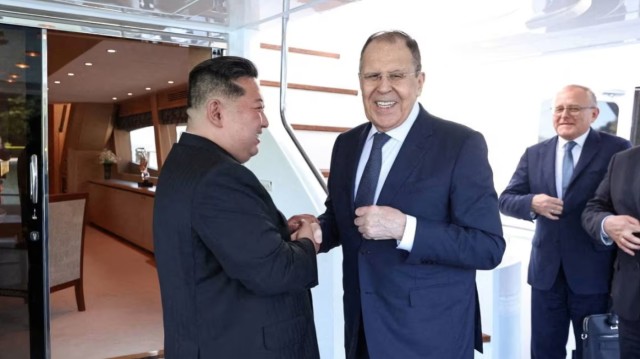
North Korean leader Kim Jong Un shakes hands with Russian Foreign Minister Sergey Lavrov during a meeting in Wonsan, North Korea, Saturday.
In a display of deepening ties, North Korean leader Kim Jong Un has reiterated his country's unconditional support for Russia’s war in Ukraine. Hosting Russian Foreign Minister Sergey Lavrov in the coastal city of Wonsan, Kim assured his full backing for “all actions” Russia undertakes in Ukraine.
The rare meeting, held at the newly unveiled Kalma beach resort, marks another step in North Korea’s growing military and diplomatic alignment with Moscow. Lavrov’s visit comes at a time when Pyongyang is being increasingly pulled into the heart of the nearly three-year-long conflict.
Kim Backs All Russian Moves in Ukraine
During their meeting, Kim expressed complete solidarity with Moscow’s operations in Ukraine. According to North Korea's state media, Kim told Lavrov he “unconditionally supports and encourages all measures” Russia has taken and will take.
Photos shared by Russia’s Foreign Ministry captured a cordial moment between the two leaders—smiling, shaking hands, and conversing aboard a luxury yacht.
This affirmation of support was not merely symbolic. Ukrainian intelligence believes North Korea is preparing to send an additional 25,000 to 30,000 soldiers to the war front, on top of the estimated 11,000 deployed in 2023.
A Strategic Visit at a Crucial Time
Lavrov’s arrival in Wonsan underscores a rapidly strengthening alliance. His three-day visit included a separate meeting with North Korea’s Foreign Minister Choe Son Hui. At a press conference, Lavrov said the countries had “exchanged views on the Ukrainian crisis,” and praised North Korea’s firm alignment with Russian goals.
Meanwhile, the U.S. has voiced growing frustration with Moscow. Former President Donald Trump criticized President Vladimir Putin for hindering peace talks and vowed increased support for Ukraine.
The Lavrov-Kim meeting could reshape not just the war, but also security dynamics across Asia.
What’s North Korea Getting in Return?
The deeper question looming over this partnership is: what does Pyongyang gain?
Professor Robert Kelly from South Korea’s Pusan National University speculates that weapons technology is part of the bargain. Guidance systems, warhead reentry tech, and drone capabilities could be among the assets Russia is transferring to North Korea—technologies the North has long sought but lacked.
He also suggested Russia may be paying Pyongyang per soldier deployed, offering both financial and technological incentives. These gains come with a grim cost: thousands of North Korean soldiers are reportedly dying on foreign soil, while the regime trades lives for advanced military gear.
Kalma Resort: A Strategic Showcase
Interestingly, the meeting took place at North Korea’s new Kalma beach resort, a lavish complex featuring high-rise hotels, waterparks, and accommodation for nearly 20,000 guests. Kim personally inaugurated the project, aimed at drawing foreign tourists and earning hard currency.
Lavrov said he hoped Russian tourists would soon visit the area and noted efforts were underway to facilitate travel, including air connectivity. The resort sits next to an international airport, another sign that North Korea is seeking economic openings despite sanctions.
Evidence of North Korea’s Growing Role in the War
Western intelligence reports point to North Korea’s increasing military integration in Russia’s campaign. Satellite imagery shows regular movement of cargo planes and ships between the two nations, indicating large-scale logistics coordination.
In the Russian border region of Kursk, North Korean soldiers are reportedly fighting alongside Russian troops, living in harsh battlefield conditions. Around 4,000 North Korean soldiers are believed to have been killed or wounded.
Russia, facing manufacturing limitations, has grown reliant on North Korean weapons. Translated training manuals and artillery shells supplied by Pyongyang point to increasing military interoperability. A recent UN report revealed that in 2024 alone, North Korea sent over 100 ballistic missiles and 9 million artillery shells to Russia.
Ukraine Holds Its Ground
Despite intensified Russian attacks—over 3,000 drones and missiles launched in a week—Ukraine’s air defenses are holding firm. President Volodymyr Zelensky praised the performance of Ukrainian interceptor drones, especially in neutralizing Russian-Iranian Shahed drones.
Still, the human toll continues. Nine people were killed and 23 injured across Ukraine in just the past 24 hours, local authorities said.
A New Axis Emerges
As Lavrov departs for China to join the Shanghai Cooperation Organisation, the message from North Korea is clear: its alliance with Russia is stronger than ever. With soldiers on the battlefield, weapons in shipment, and high-level diplomacy on display, Pyongyang is no longer a silent bystander—it is an active participant in shaping the conflict’s future.