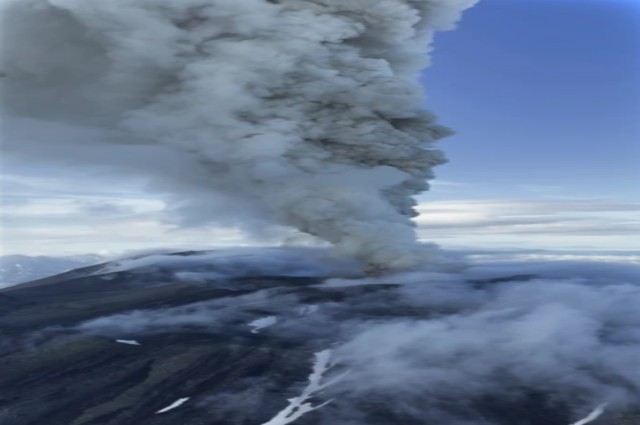
This photo taken from video by Artem Sheldr shows an aerial view of the eruption of the Krasheninnikov volcano of the Eastern volcanic belt, about 200 km (125 miles) northeast of the regional center of Petropavlovsk-Kamchatsky, Russia far east, Sunday, Aug. 3, 2025.
Russia’s Krasheninnikov volcano has erupted for the first time in centuries, lighting up the skies over Kamchatka Peninsula. The dramatic eruption followed days after a massive 8.8-magnitude earthquake rocked Russia’s Far East.
Fiery Ash Cloud Rises Over Kamchatka
The long-dormant volcano sent a plume of ash nearly 6 kilometers (3.7 miles) into the atmosphere. Located inside the Kronotsky Nature Reserve, the volcano's sudden eruption surprised many scientists.
Images broadcast by state media captured thick, dark ash clouds billowing above the snowy volcanic peak. The ash plume stretched eastward, heading over the Pacific Ocean. Fortunately, officials confirmed that no towns or villages lay in the path of the drifting cloud.
Earthquake and Tsunami Warning Add to Chaos
The eruption came just days after the massive earthquake on Wednesday. That quake, measuring 8.8 in magnitude, triggered small tsunami waves as far as Alaska and Japan.
On the night of the eruption, a separate 7.0-magnitude earthquake shook Kamchatka. Authorities issued a tsunami warning for three coastal areas. However, Russia’s Ministry for Emergency Services lifted the alert after confirming no significant sea level rise.
First Confirmed Eruption in Six Centuries
"This is the first historically confirmed eruption of the Krasheninnikov volcano in 600 years," said Olga Girina, who leads the Kamchatka Volcanic Eruption Response Team. Her team closely monitors volcanic activity in this seismically active region.
However, there’s a minor dispute. The Smithsonian Institution’s Global Volcanism Program claims Krasheninnikov last erupted in 1550—about 475 years ago. The reason for the conflicting data remains unclear.
Volcano Still Active, but Calming
Despite the fiery display, experts say the eruption is already starting to slow. The Kamchatka Volcanic Eruption Response Team reported that activity had decreased by late Sunday. Yet they cautioned that "moderate explosive activity" could continue in the coming days.
Volcanologists are keeping a close eye on any aftershocks or further eruptions. With the region sitting on the volatile Ring of Fire, seismic surprises are always a possibility.
Kamchatka’s Volcanic Zone: A Fiery Frontier
The Kamchatka Peninsula is one of the most volcanically active zones on Earth. It hosts over 300 volcanoes, 29 of which are active. The area is part of the Pacific Ring of Fire, a hotspot for both earthquakes and volcanic eruptions.
Krasheninnikov, though not well-known globally, is now making headlines. The eruption serves as a reminder of nature’s unpredictable power and the importance of monitoring volcanic zones closely.
No Harm to Locals – For Now
Officials reassured the public that no communities were affected by the ashfall. Emergency services are continuing to track ash dispersion and potential threats.
Residents near the region have been urged to stay alert but calm, as scientists monitor seismic readings and volcanic activity closely.
A Dramatic Return After Centuries
Krasheninnikov’s awakening marks a rare event in Russia’s geological history. Whether it becomes an ongoing threat or a short-lived eruption remains to be seen. For now, Kamchatka’s skies are clearing—but the ground below remains restless.