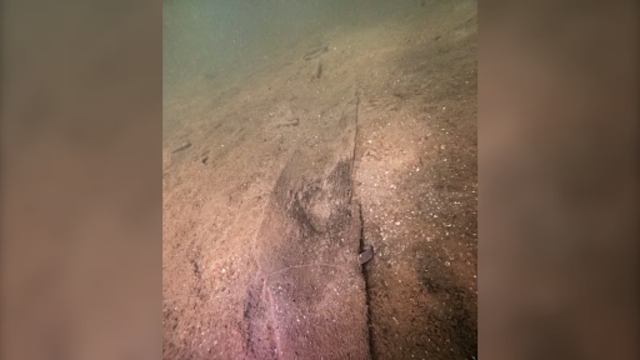
This photo, shared by Wisconsin Historical Society maritime archaeologist Tamara Thomsen, shows an ancient canoe resting on the bottom of Lake Mendota in Madison in June 2025. AP
Archaeologists in Wisconsin revealed a rare discovery along the floor of Lake Mendota. They located 16 ancient canoes, all left behind by Indigenous people who travelled through the region thousands of years ago. Experts believe the site once served as a shared canoe drop-off point, much like a simple travel hub for anyone passing through.
Tamara Thomsen, the state’s maritime archaeologist, said the location sits near old Indigenous travel routes. She compared the setup to a “parking spot that’s been used for millennia,” where travellers likely stored their canoes before continuing on foot.
A Lake Rich With History
Lake Mendota covers about 15 square miles on Madison’s west side. The area sits close to the State Capitol and the University of Wisconsin campus. Researchers began making discoveries there in 2021 when they uncovered a 1,200-year-old canoe in 24 feet of water.
The next year brought even more surprises. Archaeologists found a 3,000-year-old canoe, a 4,500-year-old canoe under it, and another canoe dating back 2,000 years nearby. These findings hinted at a larger site, and Thomsen continued searching with support from UW-Madison professor Sissel Schroeder and tribal preservation officers from the Ho-Chunk Nation and the Bad River Band of Lake Superior Chippewa.
Their work revealed 12 more canoes, bringing the total to 16. Radiocarbon testing showed the oldest canoe dates back 5,200 years, making it the third-oldest known canoe found in eastern North America. The oldest two come from Florida, with the most ancient dating back 7,000 years.
Why the Canoes Stayed Preserved
Thomsen explained that Wisconsin went through a long drought starting about 7,500 years ago. During that time, the lake near the canoe site was no deeper than four feet. This made it a natural point for travellers to leave the water and continue their journeys on foot.
Indigenous communities likely shared the canoes. Travellers often buried the boats in soft lake sediment to keep them wet. This prevented cracking in summer heat and helped protect them from freezing in winter.
According to state archaeologist Amy Rosebrough, travellers may have been headed toward Lake Wingra, a lake south of Madison that remains spiritually important to the Ho-Chunk Nation. One spring that feeds Lake Wingra holds special cultural meaning, believed to connect the living world with the spirit world.
Bill Quackenbush, the Ho-Chunk tribal preservation officer, said, “The canoes remind us how long our people have lived in this region and how deeply connected we remain to these waters and lands.”
What Comes Next
Thomsen believes older canoes could still be hidden below the ones already found. If the drought began 7,500 years ago and canoes accumulated over time, a 7,000-year-old canoe might still lie buried under the layers.
Though Thomsen studies Great Lakes shipwrecks most days, she works on the canoe project once a week. She called this work the most meaningful of her career because it connects her directly to tribal communities and their history. “Each one of these canoes gives us another clue to the story,” she said.