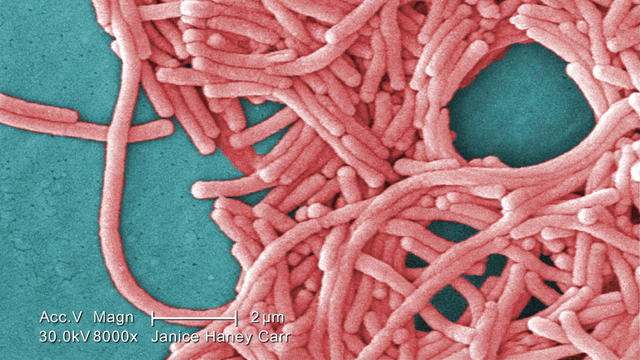
This color-enhanced image from 2009, shared by the U.S. Centers for Disease Control and Prevention, shows a close-up view of Legionella pneumophila bacteria, which can cause Legionnaires' disease. The photo reveals a large cluster of these harmful bacteria magnified 8,000 times. CTV
A sudden outbreak of Legionnaires’ disease in London, Ontario has infected over 40 people and raised concerns about public safety. One person has died, and health officials continue to search for the cause. The cases have all appeared within a six-kilometre area, though authorities believe the overall risk remains low.
What Is Legionnaires’ Disease?
Legionnaires’ disease is a serious lung infection caused by Legionella bacteria. It causes a type of pneumonia that brings on fever, cough, and shortness of breath. The illness doesn’t spread from person to person. People can only catch it by breathing in small water droplets containing the bacteria.
The bacteria live naturally in soil and water. However, outbreaks usually happen when it grows in man-made water systems. These include cooling towers, HVAC systems, hot tubs, and fountains. Dr. Isaac Bogoch, a physician who specializes in infections, says it’s often linked to systems that spray or mist water into the air.
“You don’t catch it from people,” Dr. Bogoch explains. “You breathe it in from places like air conditioners or cooling towers.”
Who Is at Risk?
Although the disease is not common, certain people are more likely to get sick. Older adults, smokers, and those with weak immune systems or chronic lung problems face the highest risk.
Health officials say most people exposed to the bacteria won’t get sick. Still, they urge caution. Between June and September, the chances of infection rise. The bacteria grow more easily in warm, moist conditions, especially during summer.
How Often Does It Happen?
Public health reports show 363 confirmed cases of Legionnaires’ disease in Ontario in 2024. That number is close to the annual average. London had the highest rate, with 7.7 cases for every 100,000 people. By comparison, most of the Greater Toronto Area had fewer than two cases per 100,000 people.
What’s Happening in London?
The local health unit confirmed over 40 cases in recent days, all clustered in the same part of the city. One patient has died. Officials say they don’t yet know the source of the infection but continue to investigate. They have not ruled out any water systems in the area.
A health unit spokesperson said, “Most people exposed to legionella won’t get sick. The risk is low, but we’re watching the situation closely.”
Treatment and Prevention
Doctors treat Legionnaires’ disease with common antibiotics used for pneumonia. When a case is confirmed, public health teams begin tracing its source. They try to find a shared location among patients, such as a mall, church, or hotel. This helps them identify where the bacteria may have spread from.
Where Does the Name Come From?
The illness got its name in 1976. That year, a group of veterans attending an American Legion convention in Philadelphia fell ill with a strange lung infection. Investigators later found the Legionella bacteria in the hotel’s cooling system.