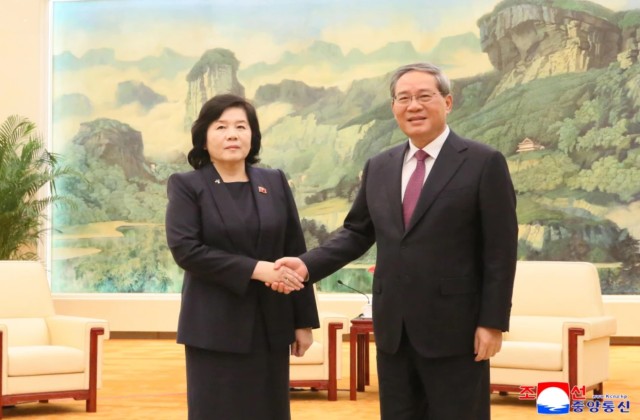
This photo provided on Sept. 30, 2025, by the North Korean government, Chinese Premier Li Qiang, right, meets with North Korean Foreign Minister Choe Son Hui at the Great Hall of the People in Beijing, Monday, Sept. 29, 2025.
China’s Premier Li Qiang is set to visit North Korea this week in the most significant diplomatic exchange between the two nations since 2019. The visit signals a renewed phase in China–North Korea relations amid shifting alliances and growing global tensions.
Strengthening China–North Korea Ties
The Chinese Foreign Ministry confirmed that Li will lead a government delegation to North Korea from Thursday to Saturday. The visit will coincide with celebrations marking the 80th anniversary of the founding of the ruling Workers’ Party of Korea.
China described the two nations as “traditional friends and neighbors,” emphasizing that maintaining and developing bilateral ties remains a “firm strategic policy” of the Chinese Communist Party and government. The visit underlines Beijing’s ongoing commitment to Pyongyang despite global scrutiny and geopolitical shifts.
High-Level Attendance Marks Regional Cooperation
North Korea’s anniversary celebrations will see participation from several regional leaders. Russia will be represented by former President Dmitri Medvedev, while Vietnam’s top leader, To Lam, will also attend. This will mark the first visit by a Vietnamese leader to North Korea since 2007, according to Vietnamese state media.
Additionally, the president of Laos, Thongloun Sisoulith, who also serves as general secretary of the Lao People’s Revolutionary Party, is expected to join the events. The presence of multiple Southeast Asian and Eurasian leaders underscores Pyongyang’s growing diplomatic engagement in Asia.
Li Qiang’s Expanding Global Role
Li Qiang, currently serving as China’s premier and a member of the elite seven-member Standing Committee of the Communist Party’s Politburo, is widely considered the second-most powerful leader in China after President Xi Jinping.
As Xi reduces his international travel, Li has increasingly represented China in key global forums and foreign visits. His trip to North Korea reinforces China’s intent to assert its influence in regional politics and maintain its position as a major ally to Pyongyang.
A Delicate Diplomatic Balance
While China remains North Korea’s most significant economic and political supporter, Kim Jong Un has in recent years attempted to diversify his alliances. Strengthening ties with Russia, Kim has shown public support for Moscow’s ongoing war against Ukraine and has reportedly supplied military aid to the Kremlin.
This move has not only drawn attention from the West but also highlighted the growing trilateral cooperation between North Korea, China, and Russia—an alignment viewed as a counterbalance to U.S. and Western influence in the region.
Renewed High-Level Contacts
Recent months have witnessed an uptick in China–North Korea interactions. Earlier this year, Zhao Leji, another senior Chinese Politburo member, visited Pyongyang and met with Kim Jong Un. The meeting reaffirmed mutual trust and cooperation between the two countries.
Kim Jong Un also visited China last month, where he attended a Chinese military parade in Beijing alongside Russian President Vladimir Putin and other international figures. The back-to-back exchanges suggest both nations are seeking closer coordination on diplomatic and defense matters.
Strategic Importance of the Visit
Premier Li’s upcoming visit is more than a ceremonial gesture—it reflects China’s strategic push to deepen its influence on the Korean Peninsula. With global power dynamics shifting, Beijing aims to fortify its network of allies and reaffirm its leadership role in Asia.
As regional partnerships evolve, Li Qiang’s trip marks a pivotal step in reaffirming the long-standing friendship between China and North Korea—one rooted in shared ideology, history, and strategic necessity.