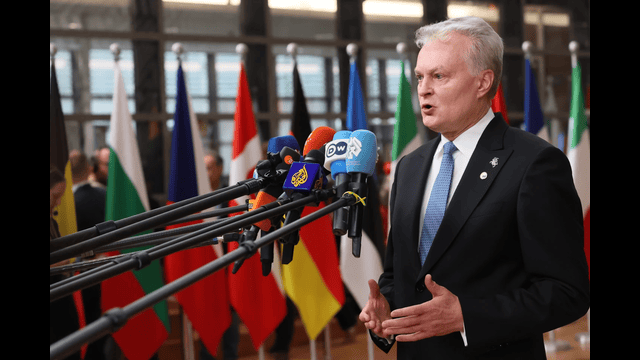
Lithuania’s President Gitanas Nauseda speaks with the media as he arrives for an EU Summit at the European Council building in Brussels, Thursday, Oct. 23, 2025.
Lithuania has accused Russia of violating its airspace, marking a serious escalation in regional tensions. On Thursday evening, two Russian military aircraft briefly entered Lithuanian airspace — an act President Gitanas Nausėda described as a “blatant breach of international law and Lithuania’s territorial integrity.”
Lithuania Demands Answers from Moscow
Following the incident, Lithuania’s Foreign Ministry announced plans to summon Russian Embassy officials in Vilnius to issue a formal protest. The Lithuanian president shared his outrage on social media, emphasizing that the violation underlines the “urgent need to strengthen European air defence readiness.”
So far, the Russian government has made no public comment on the matter.
Russian Jets Cross Lithuanian Border
According to a statement from Lithuania’s armed forces, the airspace breach occurred around 6 p.m. local time. Two Russian aircraft — an SU-30 fighter jet and an IL-78 refueling plane — crossed roughly 700 meters (765 yards) into Lithuanian territory. The incursion lasted approximately 18 seconds before the planes turned back.
Officials believe the aircraft were likely conducting refueling exercises over the nearby Russian exclave of Kaliningrad.
NATO Responds Swiftly
As part of NATO’s air policing mission in the Baltic region, two Spanish fighter jets were immediately scrambled in response. They flew out to monitor the area and ensure no further violations occurred.
This swift reaction highlights NATO’s commitment to defending the airspace of its member nations, especially in regions bordering Russia.
Rising Tensions in the Baltics
The Baltic nations — Lithuania, Latvia, and Estonia — have been on high alert since Russia’s invasion of Ukraine. In recent weeks, reports of mysterious drones and airspace intrusions have sparked growing fears that Moscow is testing NATO’s readiness.
Some European leaders have accused Russian President Vladimir Putin of conducting a “hybrid war” to intimidate neighboring countries. The Kremlin, however, denies any such actions, claiming its military activities are routine and confined to Russian territory.
Europe Pushes for Defense Readiness
Earlier on the same day as the airspace violation, President Nausėda attended a European Council summit in Brussels. During the meeting, EU leaders approved a new initiative called “Readiness 2030,” a plan aimed at ensuring Europe can defend itself against external threats by the end of the decade.
Nausėda’s remarks after the incident reinforced the urgency of the EU’s defense goals. He emphasized that incidents like this demonstrate why Europe must boost collective air surveillance, invest in modern defense systems, and enhance coordination between NATO allies.
A Growing Pattern of Provocations
This latest airspace breach adds to a growing list of confrontations between Russia and NATO countries. In recent months, Russian jets have been detected flying close to NATO borders without transponders, increasing the risk of miscalculations and potential conflict.
Experts warn that such provocations are part of Moscow’s broader strategy to test the alliance’s unity and response time. For Lithuania — a small Baltic state sharing borders with both Russia and Belarus — these violations are a stark reminder of its geographical vulnerability.
Lithuania Stands Firm
Despite the provocation, Lithuania remains resolute. President Nausėda reiterated that his country will not be intimidated and will continue to work closely with NATO and EU allies to safeguard its sovereignty.
“This act of aggression only strengthens our resolve to defend every inch of NATO territory,” he declared.
The incident underscores a growing sense of urgency across Europe — that in an increasingly unstable world, stronger collective defense is not just an option, but a necessity.