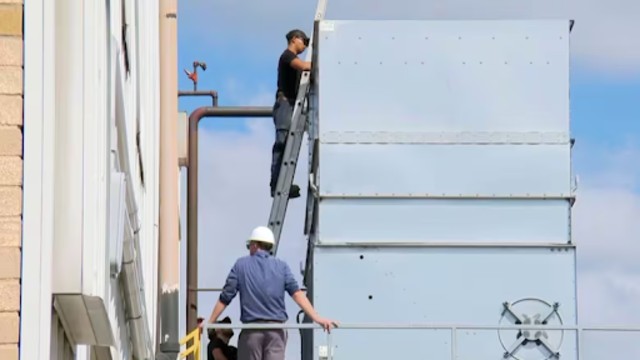
Workers are seen cleaning the cooling towers at a London, Ont., meat-processing plant identified as the source of a legionnaires’ outbreak.
A deadly outbreak of legionnaires’ disease in London, Ontario, has claimed a fifth life. The city is facing its second outbreak in two years, and legal action worth millions is now underway.
A Community on Edge
The latest death comes as frustration mounts. Dozens remain affected, and residents are demanding answers. Since early July, nearly 100 people have been hospitalized. Four remain in care today. Many survivors endured serious health struggles, including weeks in intensive care.
The Middlesex-London Health Unit has traced the likely source to Sofina Foods, a meat processing plant in east London. Officials believe a contaminated cooling tower spread the dangerous bacteria.
What Went Wrong?
Legionnaires’ disease is caused by legionella bacteria. They thrive in warm, stagnant water, such as in cooling towers. When tiny droplets are inhaled, they can trigger infections ranging from mild fever to life-threatening pneumonia.
Last year, two people also died in a London outbreak. Investigators linked that case to the same Sofina facility. The repeat connection has sparked outrage, and now, legal action.
The Lawsuit Taking Shape
Siskinds LLP, a London-based law firm, has filed a proposed class-action suit against Sofina Foods. The claim seeks more than $86 million in damages. Of that, $75 million would cover personal injuries and losses. Another $11 million is requested as punitive damages.
The statement of claim accuses Sofina of negligence. It alleges the company failed to clean and monitor its cooling tower, ignored risks, and did not act fast enough on health unit directives.
Linda Visser, a partner at Siskinds, said many victims suffered severe injuries. “Some were hospitalized for weeks. One person was in a medically induced coma,” she noted.
A Family’s Ordeal
The lawsuit names Justin-Eric Frank Serratore-Pimental as a primary plaintiff. He lives just three kilometres from the Sofina facility with his mother and two young sons.
Serratore-Pimental was rushed to hospital with high fever, confusion, chest pain, and breathing difficulties. Doctors diagnosed him with legionnaires’ disease, double pneumonia, and sepsis. He survived, but his life has been changed.
The claim states that the legionella strain found in Sofina’s cooling tower matches the strain that made him ill. His case is being used to anchor the broader lawsuit.
Who Can Join the Case?
The proposed suit is still awaiting certification by the Ontario Superior Court of Justice. If approved, it will cover two groups.
- Injury class: People exposed to legionella near the facility between May and September of 2024 or 2025, who became ill.
- Family class: Relatives of those infected, who also suffered losses or hardships.
Siskinds is urging affected residents to come forward.
Sofina’s Response
Sofina Foods has denied wrongdoing. In a statement, the company said it followed all guidance from public health authorities during the outbreak. It claims to have worked with outside specialists to clean, test, and maintain the tower.
The cooling system was brought back online on September 2, after receiving approval from the health unit. Sofina insists it has complied with every directive and continues to cooperate fully.
The Bigger Picture
The outbreak has also raised broader concerns. Ontario does not currently require cooling towers to be registered or regularly monitored. Lawyers argue that the absence of regulation makes it easier for such incidents to recur.
As the community mourns another life lost, questions remain. Could stronger oversight have prevented this? And will the court hold Sofina accountable?
For now, the city watches closely, waiting for justice and, above all, safety.