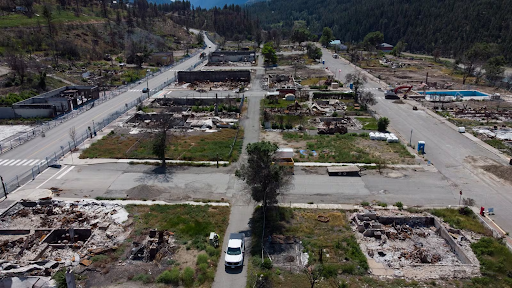
Destroyed homes and buildings from the wildfire stand in Lytton, B.C., on Tuesday, June 14, 2022. The Canadian Press
A judge in British Columbia gives approval for a class-action lawsuit against Canadian Pacific and Canadian National railways to move ahead. The decision concerns the massive fire that destroyed most of Lytton, B.C., in June 2021. The ruling comes from Justice Ward Branch of the B.C. Supreme Court. He says there is “some basis in fact” to support claims that railway activity may have caused the fire.
The fire tore through the village during an intense heat dome. The community recorded a national temperature high of 49.6 C the day before flames swept through. Two people died, homes vanished in minutes, and hundreds of residents fled with little warning.
Multiple Claims Come Together
Several lawsuits followed the disaster, including cases from individuals, families, and First Nations. Another class-action attempt failed in 2023, but this one received approval to go forward. The newly certified action brings together people who suffered losses in the fire, as well as two subclasses. One subclass covers relatives of people who died. Another includes those who lost property that insurance did not cover.
The judge notes that both CN and CP run trains on parallel tracks through the centre of Lytton. The lawsuit claims sparks or heat from railway operations may have ignited nearby dry ground. While the court has not ruled on the truth of these claims, the decision allows plaintiffs to argue their case in full.
Lead Plaintiff Lost Home and Business
The main representative plaintiff is Carel Moiseiwitsch. She lost her home and her family’s home-based information technology and design business. She says the fire forced her to run for her life. She also says she still feels the trauma of losing her home, her cat, and the life she built in the village. The judge includes her claims as part of the broader class action.
Another lead plaintiff, Jordan Spinks, belongs to the Kanaka Bar Indian Band. He says the fire pushed him from his home for months. He also says he lost his job and struggled with the emotional toll that followed. His experience forms part of the case, reflecting the deep impact on Indigenous residents.
Fire’s Legacy Still Felt in Lytton
The class action includes people who lived through the blaze, lost property, or endured long-term disruptions. Many lost irreplaceable belongings. Others lost entire livelihoods. The certification ruling does not decide who caused the fire. It simply confirms that the claims deserve a full hearing.
The case now moves forward as part of an effort to seek answers and recovery. Many residents continue to rebuild their lives more than four years after the disaster.