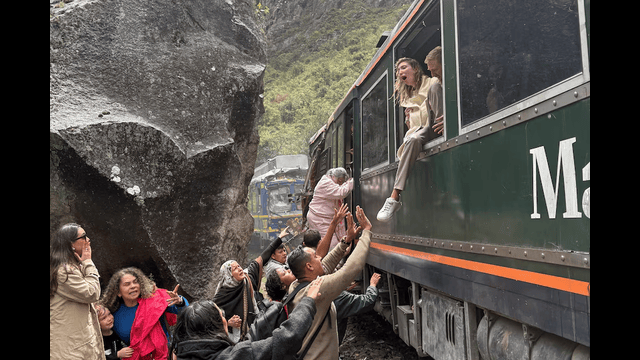
People evacuate a train carriage after two trains collided on the railway leading to the Inca citadel of Machu Picchu in Peru.
A deadly Machu Picchu train crash disrupted travel to Peru’s most famous tourist site on Tuesday afternoon.
Two trains carrying tourists collided on a narrow rail stretch, killing one person and injuring at least 30 others.
Authorities confirmed the victim was a railway worker who died at the scene.
Most of the injured passengers were tourists heading to or returning from Machu Picchu.
Emergency teams rushed to the remote location to assist victims and secure the rail line.
Machu Picchu Train Crash Halts Rail Services
Police said the accident occurred near Qoriwayrachina, an archaeological area along the route.
The site sits between the city of Cuzco and the town of Aguas Calientes.
Jhonathan Castillo Gonzalez, a captain with the Cuzco police, confirmed the fatality.
He said train services on the Machu Picchu line were immediately suspended.
Railway officials stated that one train was leaving Machu Picchu when it struck another approaching the site.
The collision happened in the early afternoon under still-unclear circumstances.
Cause of the Machu Picchu Train Crash Still Unknown
Investigators have not yet released the cause of the Machu Picchu train crash.
Officials said technical inspections and crew statements are underway.
Weather conditions at the time were not reported as severe.
No mechanical failures have been officially confirmed so far.
Authorities said updates will follow once the investigation progresses.
Shocking Scenes Captured Near the Crash Site
Local media shared videos from the accident location.
The footage showed damaged train cars stranded along the tracks.
Several windows were shattered.
Metal sides appeared dented from the impact.
The rail line runs through dense forest and steep rock walls.
Rescue access was limited due to the terrain.
Machu Picchu Tourism Heavily Dependent on Trains
Machu Picchu attracts about 1.5 million visitors every year.
Most tourists rely on trains to reach the site.
Travelers typically arrive by rail to Aguas Calientes.
From there, buses and footpaths lead to the ancient ruins.
The iconic Inca city was built in the 15th century.
It served as a royal sanctuary for Inca emperors.
Its precisely cut stone structures remain a global marvel.
Growing Tourism Pressures and Past Disruptions
Visitor numbers to Machu Picchu have risen nearly 25% over the past decade.
This growth has placed added pressure on transport infrastructure.
Tourism in the region has also faced repeated disruptions.
Political unrest and management disputes have impacted access.
Protesters have occasionally blocked the railway to Machu Picchu.
Such actions have stranded tourists in the past.
Alternative Routes to Machu Picchu Remain Open
Machu Picchu can also be reached on foot.
Some visitors choose a multi-day trek instead of the train.
The journey often begins in the town of Ollantaytambo.
The hike typically takes four days to complete.
Officials have not said when rail services will resume.
Tourists are advised to monitor official updates closely.