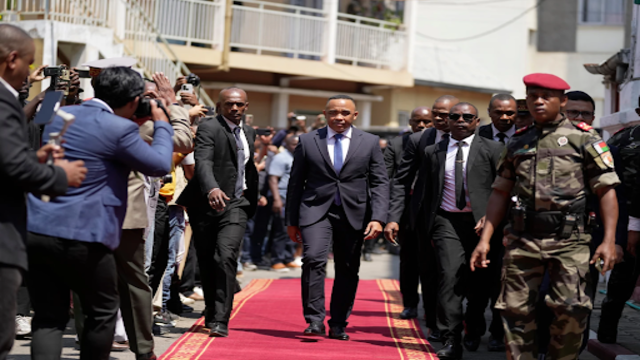
Col. Michael Randrianirina arrives at the high constitutional court to be sworn in as President in Antananarivo, Madagascar, Friday, Oct. 17, 2025. Associated Press
In a swift and unexpected coup, Madagascar’s elite army commander, Col. Michael Randrianirina, has taken over as the nation’s new president. The move followed weeks of protests that spiraled into chaos, forcing President Andry Rajoelina to flee the country.
A Swift Power Grab
Just three days after declaring military control, Randrianirina was officially sworn in at Madagascar’s High Constitutional Court. Surrounded by nine red-robed judges, the colonel took the oath of office, marking a dramatic shift in power on the island nation of 30 million.
The coup unfolded rapidly, leaving the country reeling. The U.N. has condemned the takeover as an unconstitutional change of government, while Madagascar now faces suspension from the African Union.
Protests Spark Political Upheaval
The takeover followed three weeks of youth-led demonstrations across the country. What began as anger over chronic water and power shortages soon grew into nationwide outrage against Rajoelina’s government.
According to U.N. reports, at least 22 people were killed during the protests amid clashes with security forces. The growing unrest gave Randrianirina the opportunity to step in, positioning himself as a voice for the frustrated youth.
Randrianirina’s Call for Change
In his first presidential address, Randrianirina pledged to bring “profound change” to Madagascar’s leadership. Standing beside the national flag, he urged citizens to unite for peace and promised to “end the harmful practices of the past.”
The new president’s message struck a chord with many, especially among the younger generation who led the movement. However, questions remain about whether the coup was truly for the people—or a strategic military power play.
Ousted President in Hiding
Former President Rajoelina has reportedly gone into hiding after fleeing the country, citing threats to his life. Local media claim he escaped aboard a French military plane.
Parliament swiftly voted to impeach Rajoelina earlier this week, paving the way for the colonel’s announcement that the army would assume control. His absence has left the political landscape in disarray, with much of the international community still uncertain how to respond.
From Soldier to Head of State
Until recently, Col. Randrianirina was little known outside military circles. The 50-year-old led the CAPSAT elite unit, which played a decisive role in the rebellion. Dressed in a dark suit and blue tie, he appeared calm as he took his oath before military officials, diplomats, and dignitaries.
Notably, Randrianirina had once been imprisoned for an attempted mutiny in 2023, spending three months in custody. Now, he has risen from the ranks to become the most powerful man in Madagascar.
Military Rule for Up to Two Years
The colonel has announced that Madagascar will be governed by a military council for 18 months to two years before fresh elections are held. While he insists this is a temporary measure, analysts warn that extended military rule could delay democracy even further.
Many young protesters, who initially demanded better governance, now face uncertainty about when they can choose their next leader.
Youth-Led Uprising Gains Global Attention
Madagascar’s youth protests mirror other Gen Z-led movements around the world, from Sri Lanka to Nepal. What began as demonstrations over living costs and blackouts grew into a call for accountability, fairness, and opportunity.
As the movement gained momentum, Randrianirina and his soldiers joined the crowds, demanding Rajoelina’s resignation. One CAPSAT soldier was killed in a brief clash with forces loyal to the former president.
Despite tensions, the coup has been met with surprising celebration in the capital, Antananarivo, where soldiers have been greeted with cheers and support.
Global Condemnation of the Coup
While many citizens see hope in the colonel’s rise, the international community remains cautious. The United Nations, African Union, and European Union have all condemned the coup.
U.N. Secretary-General António Guterres called for an immediate return to constitutional order, while the African Union “totally rejected” the military takeover. The EU urged Madagascar to restore democratic values through dialogue.
A Nation at a Crossroads
Madagascar, known for its vanilla exports and iconic lemurs, has a long history of political turmoil. The latest coup adds to decades of instability since independence in 1960.
Randrianirina’s promise of reform offers hope—but for many, it also raises fears of yet another chapter in the country’s cycle of power struggles. Whether this military-led transition leads to real change or deepens division remains to be seen.