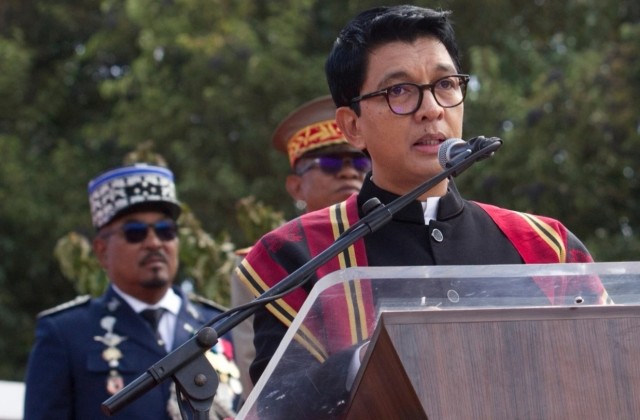
President Andry Rajoelina addresses a state ceremony, Sept. 2, 2025, in Antananarivo, Madagascar.
Madagascar is once again gripped by political turmoil. President Andry Rajoelina confirmed late Monday that he fled the country “to protect his life” following a military rebellion. Speaking from an undisclosed location on social media, he denied resigning but acknowledged the gravity of the crisis shaking the island nation.
His address was originally meant for national television but was delayed after soldiers reportedly attempted to seize control of the state broadcaster. Eventually, the video surfaced on the presidency’s official Facebook page.
Military Revolt Sparks Political Unrest
For weeks, Madagascar has faced intense anti-government protests led by young citizens calling themselves “Gen Z Madagascar.” The unrest escalated sharply on Saturday when CAPSAT — an elite military unit — joined the protesters and demanded the president’s resignation.
In response, Rajoelina declared that an “illegal attempt to seize power” was underway and fled the country. While he did not reveal his destination, reports suggest he may have been evacuated on a French military aircraft — a claim the French government declined to confirm.
President Calls for Calm and Dialogue
In his speech, Rajoelina appealed for calm and urged all sides to respect the constitution. He called for dialogue to “find a peaceful solution” but provided no details about his next steps. His silence on his whereabouts further fueled speculation about whether he would return to Madagascar soon.
CAPSAT Declares Control Over Armed Forces
The CAPSAT unit has claimed control of Madagascar’s military. Colonel Michael Randrianirina, the group’s commander, said the army had “responded to the people’s calls” but insisted this was not a coup. He emphasized that the future leadership of Madagascar should be determined by the people through elections.
Reports indicate that the defense minister has accepted CAPSAT’s authority in Rajoelina’s absence. Other military and gendarmerie units are also believed to support the rebellion.
Although tensions remain high, the weekend saw little major fighting. Soldiers in armored vehicles waving national flags were greeted by cheering crowds in Antananarivo, reflecting public frustration with the government.
Worsening Crisis and International Concern
The U.S. Embassy in Madagascar has warned of a “highly volatile and unpredictable” situation, urging citizens to remain indoors. The African Union has called for “calm and restraint” from all parties, while the United Nations has expressed alarm over the growing violence.
According to UN figures, at least 22 people have been killed and dozens injured in three weeks of protests. The demonstrations, which began over power and water shortages, have since grown into a broader movement against corruption, poor governance, and economic inequality.
Civic groups, students, and trade unions have joined the demonstrations, demanding reforms and accountability. Authorities have imposed nighttime curfews in Antananarivo and several other cities to control the unrest.
Gen Z Movement Drives Change
The Gen Z-led protests have been organized primarily through social media, inspired by similar movements in Sri Lanka and Nepal. Their demands reflect widespread frustration among Madagascar’s youth, who face unemployment, poverty, and limited access to education.
What started as a campaign against electricity blackouts has evolved into a full-fledged movement calling for systemic political change.
Madagascar’s History of Political Upheaval
Madagascar’s political instability runs deep. Since gaining independence from France in 1960, the island has witnessed multiple coups. Rajoelina himself first rose to power after a military-backed coup in 2009 that ousted then-President Marc Ravalomanana.
He was later elected president in 2018 and reelected in 2023, though opposition parties boycotted the latter election. His French citizenship has long been controversial among citizens who see it as a sign of foreign allegiance.
Amid the turmoil, Madagascar’s former prime minister and one of Rajoelina’s closest advisers also fled to Mauritius on Sunday. The Mauritian government confirmed their arrival but said it was “not satisfied” with the unexpected landing of their private plane.
Nation on the Edge
Madagascar now stands at a crossroads. With the president in hiding, the military divided, and protesters demanding change, the island faces one of its gravest political crises in years. Whether Rajoelina returns or a new government emerges, Madagascar’s immediate future remains uncertain — and its fragile democracy hangs in the balance.