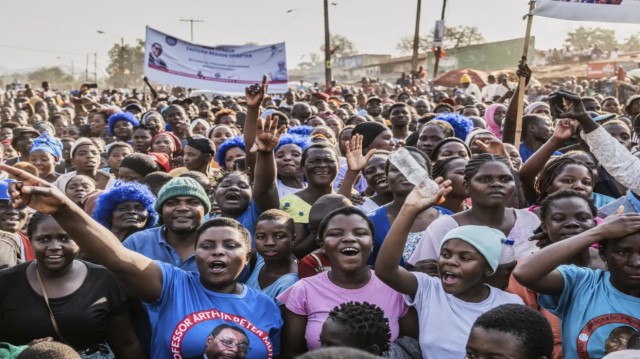
Democratic Progressive Party (DPP) supporters cheer at a campaign rally in Zomba, Malawi, Wednesday, Sept. 10, 2025.
Polls have opened in Malawi as citizens cast their votes to choose a president, members of parliament, and local representatives. The elections mark a pivotal moment for the southern African nation of 21 million people, as the outcome could reshape the country’s political and economic direction.
A Crowded Presidential Race
Incumbent President Lazarus Chakwera, 70, is seeking a second term in office. He faces 16 rivals, with former President Peter Mutharika, 85, emerging as the main challenger. The contest between Chakwera and Mutharika highlights a deep political divide, as both leaders represent different visions for Malawi’s future.
The large number of candidates reflects growing public interest in shaping the nation’s governance. However, analysts believe the real battle lies between the ruling Malawi Congress Party under Chakwera and Mutharika’s Democratic Progressive Party.
History of Contentious Elections
This is the first nationwide election since the controversial 2019 presidential vote. That election was annulled by the country’s Constitutional Court in 2020 after evidence of widespread irregularities, including tampering with tally sheets. The ruling was historic, as it marked the first time in Africa that a court ordered a fresh election after nullifying results.
The rerun in 2020 brought Chakwera to power, supported by a coalition of opposition parties. His victory was hailed as a triumph for democracy, but expectations have since collided with economic struggles, unemployment, and discontent over corruption.
Key Issues Driving the Vote
Voters in Malawi are not just choosing leaders—they are demanding solutions to urgent national problems. Rising food prices, fuel shortages, and high unemployment dominate the public discourse. Many citizens feel promises made during the 2020 campaign have not been fulfilled.
Corruption also remains a major concern. Several scandals involving government officials have raised doubts about accountability and transparency. For many voters, the elections are less about party loyalty and more about leadership that can deliver change.
Chakwera’s Pitch for Continuity
President Chakwera is asking Malawians to give him another five years to implement reforms. He argues that his administration has faced global challenges, including the COVID-19 pandemic and the war in Ukraine, which worsened economic hardships.
Chakwera insists that progress has been made in infrastructure, governance reforms, and social programs. He has pledged to intensify anti-corruption efforts and stabilize the economy if re-elected.
Mutharika’s Bid for a Comeback
Former President Mutharika, who served from 2014 to 2020, is framing his campaign around experience and economic stability. Despite his age, he has maintained strong grassroots support, particularly in rural regions.
Mutharika blames the current government for Malawi’s economic woes and has promised to restore growth and jobs. His message resonates with voters nostalgic for the relative stability of his administration, even though his final term was marred by allegations of corruption and mismanagement.
High Voter Turnout Expected
Election officials report that polling stations opened smoothly, with long queues observed in several districts. Citizens appear eager to have their say, reflecting a high level of political engagement.
Observers from regional and international bodies are monitoring the process to ensure transparency and fairness. With memories of the annulled 2019 vote still fresh, the credibility of these elections is crucial for Malawi’s democratic reputation.
What Lies Ahead
The Malawi elections are expected to be closely contested, with no clear frontrunner. If no candidate secures an outright majority, the possibility of a runoff could prolong political uncertainty.
For ordinary Malawians, the vote represents more than just a choice of leaders. It is about trust, stability, and hope for a better future. The outcome will decide whether Chakwera secures another term or whether Mutharika stages a remarkable political comeback.
As ballots are counted, Malawi—and the world—will be watching closely.