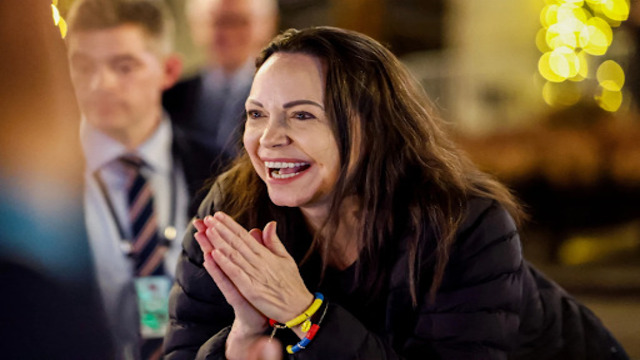
Nobel Peace Prize laureate Maria Corina Machado reacts to the crowd gathered in front of the Grand Hotel, in Oslo, Norway, early Thursday, Dec. 11, 2025. Associated Press
María Corina Machado, long seen as the unwavering face of Venezuela’s democratic resistance, has now become a Nobel Peace Prize laureate. Her public reappearance in Norway on Thursday ended an 11-month stretch in hiding and reaffirmed her commitment to restoring democracy in Venezuela.
Machado’s daughter accepted the Nobel Prize on her behalf a day earlier. After greeting supporters from a hotel balcony, Machado vowed to continue her struggle and return home as soon as security conditions allow.
A Return Fueled by Defiance
Machado had been in hiding since January 9, when authorities briefly detained her during an anti-government protest in Caracas. Though targeted repeatedly by the ruling party, she insists her return will not be dictated by the Maduro government.
“It will be as soon as possible,” she said. “My return does not depend on the regime leaving.”
Her Nobel Peace Prize, awarded on October 10, recognizes her decades-long fight to achieve a peaceful democratic transition in Venezuela.
From Engineer to Opposition Icon
Before becoming a global symbol of democratic resistance, Machado was an industrial engineer and the daughter of a steel magnate. Her activism began in 2004, when she co-founded Súmate, a civil organization that backed a recall referendum against then-President Hugo Chávez.
The effort failed, and Machado faced conspiracy accusations. Her meeting with U.S. President George W. Bush in 2005 further heightened tensions with Chávez, who viewed Washington as an enemy.
Her political career accelerated in 2010, when she won a National Assembly seat with a historic vote count. She famously challenged Chávez during a legislative session, accusing him of stealing private businesses. His retort—“An eagle does not hunt a fly”—became a defining moment in Venezuelan political memory.
Presidential Ambitions and Government Retaliation
Machado first ran for president in 2012, placing third in the opposition primary. Two years later, the ruling-party-controlled National Assembly expelled her. She was then barred from public office for a year and accused of participating in a plot to assassinate President Nicolás Maduro—charges she denied.
For nearly a decade, she kept a lower profile, supporting protests, boycotting certain elections, and criticizing opposition negotiations with the government. When she launched her 2023 presidential bid, her tone had softened, helping her connect with broader audiences.
Machado won the opposition primary with over 90% of the vote, unifying the anti-Maduro coalition. But the judiciary blocked her from appearing on the ballot, pushing her to support diplomat Edmundo González, a political newcomer.
A Campaign Under Siege
Despite obstacles, Machado continued campaigning across Venezuela. She traveled by foot, motorcycle, and highway overpasses. She sheltered in supporters’ homes and repeatedly joined massive crowds demanding “Freedom!”
González defeated Maduro by more than two-to-one, according to voting machine data verified by international observers. But the government-controlled electoral council declared Maduro the winner of the July 28, 2024, election.
Nationwide protests followed. The government responded aggressively, arresting more than 2,000 people, many linked to Machado’s movement. While some detainees were released, others—including key members of her team—fled to diplomatic compounds or left the country.
Machado reunited with her family and political allies, including González, in Norway on Thursday.
Declining Support and New Divisions
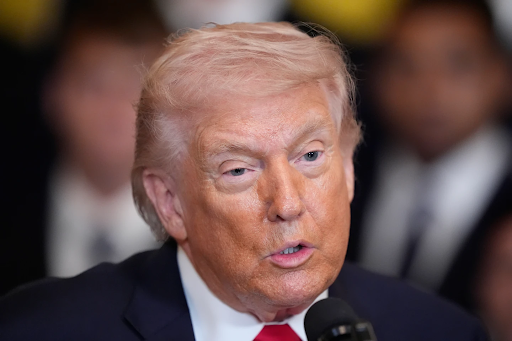
Both Machado and González saw a decline in support after they failed to prevent Maduro’s inauguration. Machado also fractured parts of the opposition due to her strong alignment with Donald Trump and support for U.S. maritime deployments in the Caribbean.
These divisions have complicated the already fragile opposition coalition. Still, Machado remains resolute.
A Call for Global Action
Machado emphasized that Venezuelans have sacrificed everything for a peaceful democratic transition. She urged foreign governments to take concrete steps, not just issue statements.
“The Maduro regime is the one that declared war on Venezuelans,” she said. “In criminal systems, the world’s democracies must support our citizens.”
Her Nobel Peace Prize shines a global spotlight on that demand—at a moment when Venezuela’s path to democracy remains fraught but far from over.