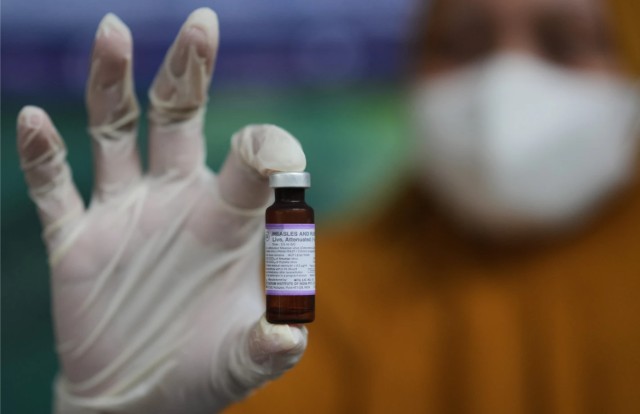
A health worker shows a vial of measles-rubella vaccine during a vaccination campaign in Sumenep on Madura Island, Indonesia, Monday, Sept. 8, 2025.
Three healthcare workers ride motorbikes through the bustling streets of Sumenep, carrying precious blue boxes of vaccines. Their mission is urgent—protect children from a dangerous measles outbreak in Indonesia. Going door-to-door, they administer life-saving shots, hoping to slow the spread of the disease.
For nine months, Madura Island has battled this outbreak. Over 2,600 children have been infected, and at least 20 lives lost. Yet, one of the greatest hurdles is not logistical—it’s cultural and religious.
Religious Concerns Slow Vaccination
A major barrier to controlling the measles outbreak in Indonesia is halal compliance. Some vaccines use pig-derived gelatin as a stabilizer, ensuring they remain effective during storage and transport. But pork is considered unclean in Islam, leading to doubts among Muslim communities.
Although many Islamic scholars permit such vaccines in urgent situations, hesitation remains. In 2018, Indonesian religious leaders declared vaccines with pig gelatin haram but allowed their temporary use until halal alternatives are found.
Still, many parents remain reluctant. Pujiati Wahyuni, a local nurse and mother, explained that some families reject vaccines entirely on religious grounds. Yet she herself vaccinated her daughter at an Islamic kindergarten, trusting the health benefits.
Government Ramps Up Vaccination Drive
To fight the measles outbreak in Indonesia, regional authorities launched a large-scale campaign in August. More than 78,000 doses were distributed through clinics, schools, and even direct home visits. The goal is simple: raise coverage, stop infections, and prevent more deaths.
However, officials admit they cannot force parents to vaccinate. Musthafa, general secretary of the Indonesian Ulema Council in Sumenep, emphasized the need for halal-certified vaccines. “We have high hopes for Muslims in Indonesia. Let us ask the government and health authorities to find halal vaccines,” he said.
A History of Measles Outbreaks
This is not Indonesia’s first battle with measles. In 2018, Papua province experienced a severe outbreak, killing dozens. Back then, religious leaders also faced the dilemma of pig-derived ingredients in the measles-rubella vaccine. They reluctantly endorsed it until a halal substitute could be developed.
Globally, measles remains a threat. According to the World Health Organization (WHO), 60 countries reported major outbreaks last year. To prevent measles, vaccination rates must reach 95%. Yet, Indonesia continues to fall short.
Declining Vaccination Rates Raise Alarm
Data from Indonesia’s Ministry of Health highlights a worrying trend. In 2023, measles-rubella vaccination rates reached 86.6% of the target. By 2024, the number dropped further to 82.3%.
The consequences are visible in Sumenep. Between May and July—the outbreak’s peak—hospitals were overwhelmed. Isolation wards were full, with more than 100 measles patients treated daily.
Mothers Torn Between Faith and Safety
Despite doubts, some parents are choosing protection. At an Islamic kindergarten in Pamolokan village, health workers urged mothers to act. For many, seeing hospitalized children was enough to shift their decision.
One mother, Ayu Resa Etika, hesitated at first because of halal concerns. But watching the outbreak’s toll convinced her. “There is a little doubt because it is not halal,” she admitted. “But this is for my child’s health. Measles can be deadly. So it’s OK, as long as the effects are good.”
Striking a Balance Between Faith and Health
The measles outbreak in Indonesia exposes the difficult balance between religious values and urgent healthcare needs. While halal concerns continue to fuel hesitancy, the rising number of cases underscores the danger of delaying vaccines.
For now, health workers will keep riding through villages, carrying cool blue boxes of hope—vaccines that could save the next child from measles.