Indian pilot Shubhanshu Shukla, Hungarian engineer Tibor Kapu, mission leader Peggy Whitson, and Polish researcher Slawosz Uznanski-Wisniewski smile for a selfie before their space mission. The team gathered at Kennedy Space Center in Florida on Tuesday, June 24, 2025, just before launching to the International Space Station aboard SpaceX’s Falcon 9 rocket. AP
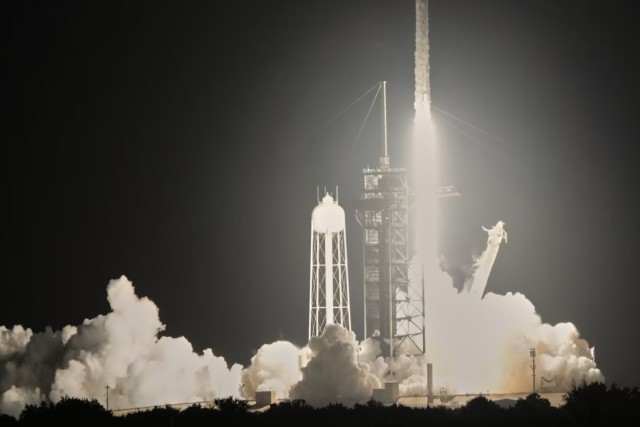
India, Poland, and Hungary sent astronauts into space together for the first time in over 40 years. Their rocket launched Wednesday from Florida, carrying the three space travelers to the International Space Station. This journey marked a special moment for all three countries, as none of the astronauts were alive when their nations first sent people to space decades ago.
Private Mission, Big Cost
The mission is a private one, arranged by a U.S. company, with each country paying over $65 million for the ride. SpaceX provided the rocket, which lifted off after a two-week delay caused by leak checks on the space station. This flight is part of a growing trend of private space trips, with commercial companies now helping more countries send people into orbit.
Meet the Crew
The crew includes India’s Shubhanshu Shukla, Hungary’s Tibor Kapu, and Poland’s Slawosz Uznanski-Wisniewski. Leading them is Peggy Whitson, a veteran American astronaut with the most experience among all U.S. space travelers. She now works with the private company organizing the trip. Each astronaut brought items from home to honor their cultures—Indian curry, Hungarian paprika paste, and Polish pierogies.
Honoring the Past
This launch holds deep meaning for the astronauts and their countries. Poland’s Uznanski-Wisniewski brought the same flag worn by Poland’s first astronaut. Hungary’s Kapu brought a teddy bear once carried by Hungary’s first space traveler in 1980. India’s Shukla is flying with a gift for his mentor, Rakesh Sharma, India’s first astronaut. These tributes show how proud each nation is of their space legacy.
Inspiring the Future
Shukla hopes this trip will inspire young people in India. He wants to show that space travel is not just for a few. He said this mission belongs to the entire country, not just him. All three astronauts plan to talk to students and people back home during the trip to share their journey.
NASA Opens the Door
This flight marks the fourth private trip to the space station organized by the U.S. company since 2022. NASA now allows more non-government travelers to visit the station. They must pay for food and support, and always travel with an experienced astronaut like Whitson. This is part of NASA’s effort to involve private companies in future space exploration, including trips to the moon.
Hope for More Missions
Poland’s Uznanski-Wisniewski said space is now open to all, not just big agencies. Hungary’s Kapu said this mission brings his country closer to the stars. Their trip was delayed a few times due to repairs and safety checks, but the rocket finally launched safely. Once in orbit, the astronauts named their capsule “Grace” and shared messages in their native languages.
Reliable Rocket, Big Dreams
The rocket used, called Falcon 9, is smaller than the newer Starship rockets that SpaceX is still testing. But Falcon 9 has proven reliable since 2020. While NASA looks to Starship for future moon missions, this smaller rocket continues to carry people safely into space.