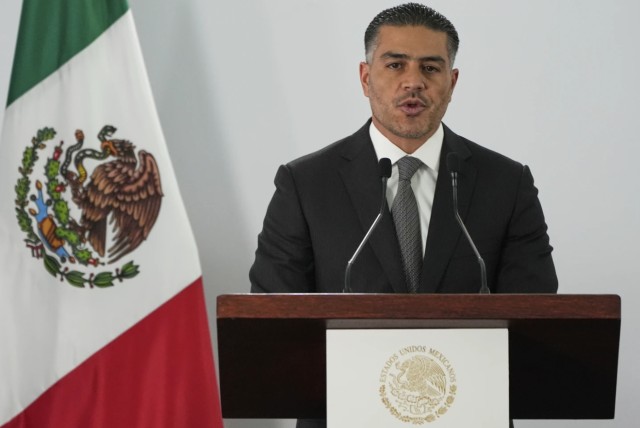
Mexican Security Minister Omar García Harfuch said Wednesday that the recent transfer of 26 alleged cartel members to the United States was aimed at ensuring they could no longer run their operations from behind bars and dismantling their networks of influence.
Mexico has handed over 26 alleged cartel leaders to the United States. Officials say the move came after a request from the Trump administration — not as part of trade or tariff talks.
The prisoners, linked to some of the most powerful criminal networks in Mexico, were sent to face justice in the US. Authorities say the goal is to stop them from running operations from behind bars in Mexico.
Security Minister Omar García Harfuch confirmed the decision at a press conference on Wednesday. He called the transfers “a strategic measure to ensure public safety” and “a way to dismantle their networks of influence.”
Not Part of Tariff Negotiations
The Mexican government stressed that the mass extradition was unrelated to ongoing negotiations with the US over tariffs. President Claudia Sheinbaum said the handovers were “sovereign decisions.”
Still, the move comes as she faces growing pressure from Washington to act against drug cartels and fentanyl production. The Trump administration has threatened tariffs of up to 30% on Mexican imports if no progress is made.
Cartel Figures from Jalisco and Sinaloa
Those extradited include members of the Jalisco New Generation Cartel and the Sinaloa Cartel. They are wanted in the US for drug trafficking and other crimes.
The transfer took place on Tuesday, involving nearly 1,000 law enforcement officers, 90 vehicles, and 12 military aircraft. It follows a similar operation in February, when 29 cartel leaders were sent to the US.
In both cases, the US Justice Department agreed not to seek the death penalty for any of the 55 individuals. Experts believe this may have reduced the risk of violent retaliation from the cartels.
Cooperation Between Mexico and the US
García Harfuch also confirmed that a non-military US drone had been flying over central Mexico. The operation was carried out at Mexico’s request as part of an ongoing investigation.
President Sheinbaum has shown more willingness to cooperate with the Trump administration compared to her predecessor. US officials have acknowledged the shift.
Two weeks ago, Sheinbaum and Trump agreed to give negotiators another 90 days to find solutions and avoid the threatened tariffs.
Buying Time with Extraditions
Security analyst David Saucedo says these extraditions are helping Mexico “buy time” in negotiations with the US. Delivering cartel leaders is one way to show progress without triggering immediate backlash.
Cartel violence often spikes after high-profile arrests or extraditions. However, Saucedo notes that recent cases suggest violent retaliation is not inevitable.
One example is Ovidio Guzmán, son of Joaquín “El Chapo” Guzmán. He pleaded guilty last month to drug trafficking in the US and is cooperating with prosecutors in hopes of a lighter sentence.
Risk of Future Violence
Despite the relative calm, Saucedo warns that mass extraditions cannot continue without consequences. Eventually, cartels may respond with violence to protect their leadership ranks.
For now, Mexico is focusing on disrupting cartel operations and showing the US it is serious about cooperation. Whether this strategy can prevent both violence and tariffs remains uncertain.
A Balancing Act for Mexico
The latest extraditions highlight Mexico’s delicate position. On one hand, the government wants to show strength against organized crime. On the other, it seeks to maintain stability and avoid retaliation.
With the threat of US tariffs still looming, Sheinbaum’s administration is walking a fine line between domestic security and foreign pressure.
For now, the message is clear: Mexico is willing to hand over high-profile criminals to the US — but insists it is doing so on its own terms.