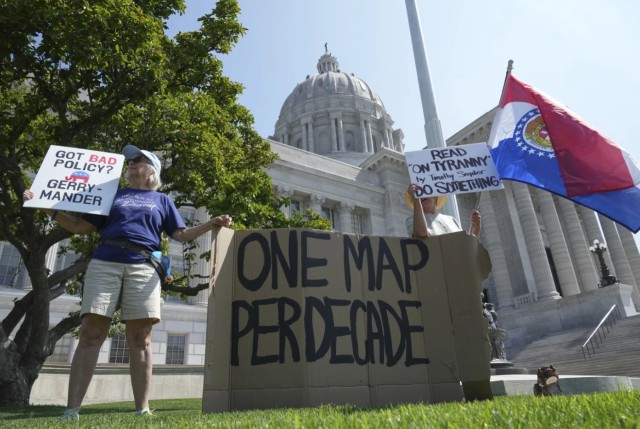
Robin Rothove, left, and Paula Smith, right, demonstrate outside the Missouri Capitol as lawmakers prepare to conduct a committee hearing inside to consider redrawing the state’s U.S. House districts, Thursday, Sept. 4, 2025, in Jefferson City, Mo.
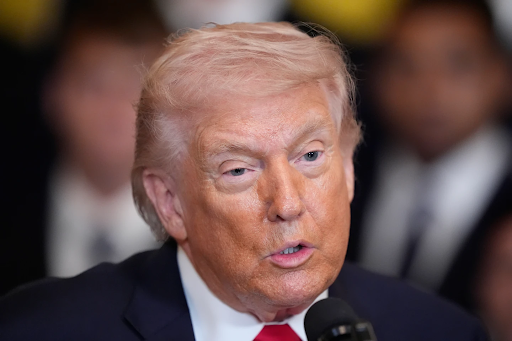
Missouri has stepped into the national redistricting battle, joining states where Republicans and Democrats are fighting for control of congressional seats. A new proposal, backed by former President Donald Trump, has already sparked heated criticism during its first public hearing.
The stakes are high. Democrats need only three more seats in the 2026 elections to regain control of the U.S. House. With midterm elections historically favoring the opposition party, both sides are aggressively maneuvering to reshape districts to their advantage.
Kansas City District Under Threat
The redistricting plan, introduced by Republican Governor Mike Kehoe, targets a long-held Democratic seat. It would stretch Democratic Rep. Emanuel Cleaver’s Kansas City-based district eastward into rural, Republican-leaning areas.
Critics argue the move dilutes urban voices by merging them with rural populations that have different priorities. Opponents also warn it could weaken representation for communities of color in Kansas City.
Community Leaders Call It “A Funeral for Democracy”
Public pushback has been strong. At a Kansas City press conference, opponents gathered near the intersection of three proposed districts.
Edgar Palacios, president of the Latinx Education Collaborative, delivered an emotional critique. Dressed in black, he declared, “It feels like we are at a funeral — a funeral for democracy in Missouri.”
Palacios accused lawmakers of gerrymandering. “This gerrymander says loud and clear: your voice, your community, your vote does not matter.”
Parents and Residents Voice Concerns
Local parents also raised concerns about how the redistricting plan would affect everyday lives.
Ashley Sadowski, a Kansas City mother of two, said the map could divide neighborhoods and schools across districts. “This means I would drive from my home in one congressional district to my son’s school in another. This does not make sense,” she said.
She added that politicians are denying children “the unified voice they deserve in Washington.”
Some rural residents also objected. Glenda Bainbridge, a Democrat from Odessa, said rural and urban needs are too different to be combined. “If they do that, people in Kansas City will not get their needs met in Congress. It dilutes their vote,” she told reporters.
City Leaders Oppose the Plan
Kansas City officials oppose the revised districts as well. Lobbyist Shannon Cooper said keeping most of the city under a single congressional representative has helped secure federal projects and jobs. Splitting it up, he warned, could weaken those efforts.
Limited Support for the Map
Only one supporter spoke in favor of the proposal during the hearing. A Missouri Right to Life leader argued that the new map could strengthen anti-abortion representation in Congress.
Redistricting Faces Legal Battles
State Rep. Dirk Deaton, the Republican sponsor of the bill, defended the proposal. He said it reduces the number of counties and cities divided between districts. “It is an improvement. It is a reform,” he insisted.
But critics note that Deaton has not disclosed demographic or partisan data for the proposed districts. Democrats argue the move is a blatant attempt to push Rep. Cleaver “into an early retirement.”
The Missouri NAACP has already filed a lawsuit challenging the special session that produced the plan. The group argues the session is unconstitutional since no extraordinary circumstance justifies redistricting without new census data or a court ruling.
Missouri’s Political Landscape
Currently, Missouri has only one competitive congressional district. Republican Rep. Ann Wagner has consistently won her suburban St. Louis seat with about 55% of the vote. Meanwhile, Rep. Cleaver has secured reelection in recent years with over 60% support.
Most of the state’s other congressional seats remain solidly Republican. If the new map passes, Democrats fear losing one of their few strongholds in Missouri.