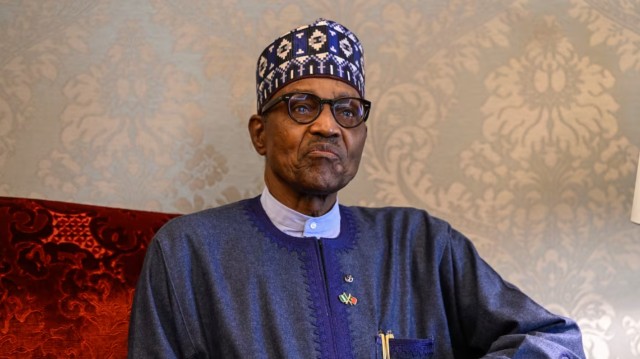
Former Nigerian president Muhammadu Buhari, during a meeting with Portuguese President Marcelo Rebelo de Sousa in Belem Presidential Palace in Lisbon, Portugal at the beginning of his state visit to the country on June 30, 2022.
Nigeria has lost one of its most influential leaders. Former President Muhammadu Buhari passed away at the age of 82. The announcement came through an official statement from the presidential press office on Sunday.
Buhari breathed his last in London around 4:30 p.m. after battling a prolonged illness. His death marks the end of an era in Nigerian politics, leaving behind a legacy defined by anti-corruption efforts and national security reforms.
Buhari’s Final Journey Begins
Following the announcement, President Bola Ahmed Tinubu expressed deep condolences to Buhari’s family. In a swift move, he ordered Vice President Kashim Shettima to travel to London.
Shettima will oversee the repatriation of Buhari’s body to Nigeria for burial with full state honors.
A Man of Many Firsts
Muhammadu Buhari’s journey to the presidency was not a smooth one. Before finally being elected in 2015, he had contested and lost three times. His persistence paid off when he unseated Goodluck Jonathan in a historic election. In 2019, Nigerians renewed his mandate for another four years.
But Buhari’s political life had started long before the democratic era. In 1983, he seized power through a military coup, becoming Nigeria’s military head of state. However, his reign was cut short in 1985 by another coup that removed him from office.
The Anti-Corruption President
Buhari’s legacy is largely shaped by his unrelenting war against corruption. As a civilian president, he made anti-graft efforts a central part of his agenda.
His administration established institutions to trace looted public funds, enforced stricter financial controls, and prosecuted high-profile cases. While some critics accused his efforts of being selective, many Nigerians saw him as a rare leader committed to cleansing a system often plagued by corruption.
In fact, former British Prime Minister David Cameron once described Nigeria as “fantastically corrupt.” Buhari took that as a challenge, using it to fuel his reforms.
Battle Against Boko Haram
Another key aspect of Buhari’s legacy was his tough stance against Boko Haram. The Islamist militant group had wreaked havoc across Nigeria’s northeast for years.
As president, Buhari prioritized military funding and counter-insurgency operations. Although the war on terror remains ongoing, his leadership helped reclaim several territories and weakened the group's grip on the region.
His experience as a former military general gave him insight and discipline in handling the crisis.
Early Life and Military Career
Born in December 1942 in Daura, Katsina State, Buhari was a Fulani Muslim raised in Nigeria’s northern region. He received military training in Kaduna, Great Britain, India, and the United States.
Buhari’s political relevance began in 1975 when a coup ousted then-leader Yakubu Gowon. He was appointed military governor of Borno State—an area that would later become central in the fight against Boko Haram.
A National Figure Remembered
Muhammadu Buhari was a man of discipline, principles, and deep conviction. Whether in military uniform or civilian clothing, he stood firm on his beliefs. Supporters viewed him as a symbol of integrity in a complex political environment.
His death comes at a time when Nigeria continues to navigate economic challenges, security threats, and political reforms.
Yet, his legacy remains etched in the nation's history.
As the country mourns, Nigerians reflect on the life of a leader who rose from military ranks to become a two-term elected president. Muhammadu Buhari may be gone, but the imprint of his leadership lives on.