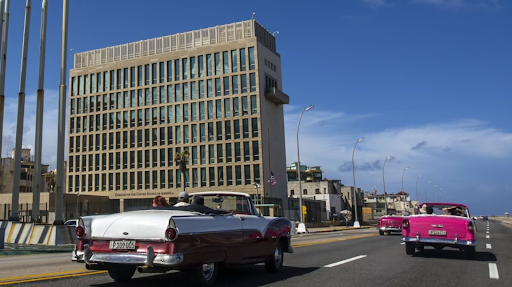
Visitors travel along Havana’s Malecón in vintage convertible cars near the U.S. Embassy in October 2017. AP Photo
U.S. Department of Defense has spent more than a year examining a device bought through a covert operation that some investigators believe may connect to a series of unexplained illnesses affecting American diplomats, intelligence officers, and military personnel. Several officials briefed on the matter say the testing continues as debate grows inside the government.
A unit within the Department of Homeland Security, known as Homeland Security Investigations, bought the device using funds provided by the Defense Department. Sources say officials paid “eight figures” for it, though they declined to share an exact amount. The purchase took place in the final days of the Biden administration.
What the device does
According to one source, the device produces pulsed radio waves. For years, some researchers and officials have suggested that such energy could explain the symptoms linked to the illness commonly called Havana Syndrome. The device includes some Russian-made parts, though it does not come entirely from Russia.
Officials have long questioned whether a powerful device could remain small enough to move easily. One source says this device could fit inside a backpack, which raises concerns about how easily it could travel.
A mystery that began in Cuba
Reports of the illness first surfaced in late 2016. American diplomats stationed in Havana began experiencing dizziness, severe headaches, and other symptoms that resembled head injuries. Similar cases later appeared in several countries.
Government investigators have tried to determine whether a foreign power carried out attacks using directed energy. Senior officials have stated in the past that evidence does not clearly support that claim. Many affected individuals disagree and say officials dismissed their concerns.
Conflicting assessments
In 2022, an intelligence panel stated that some cases could “plausibly” link to pulsed electromagnetic energy from an external source. However, in 2023, the intelligence community said it found no clear proof tying the incidents to a foreign adversary. Officials repeated that position in January 2025, while noting they could not fully rule out such a cause in a small number of cases.
Despite this, defense officials considered the findings serious enough to brief congressional intelligence committees last year. They included details about the device and its ongoing testing.
Fears of wider spread
Some officials now worry that if the technology works as suspected, other countries may also possess similar devices. That possibility raises concerns about long-term risks to U.S. personnel stationed abroad.
Investigators have not disclosed where or from whom the device came. Homeland Security Investigations often works with the military on cases involving sensitive technology, especially when such equipment appears overseas without clear explanation.
Victims demand answers
For many affected individuals, news of the device offers a sense of validation.
Marc Polymeropoulos, a former CIA officer who reported injuries after an incident in Moscow in 2017, said:
“If the [U.S. government] has indeed uncovered such devices, then the CIA owes all the victims a f**king major and public apology for how we have been treated as pariahs.”
The testing continues, but the questions surrounding the illness remain unresolved.