A sudden flash of light and a loud boom reported across British Columbia on Tuesday evening occurred when a fireball meteor passed through the atmosphere. Yahoo!
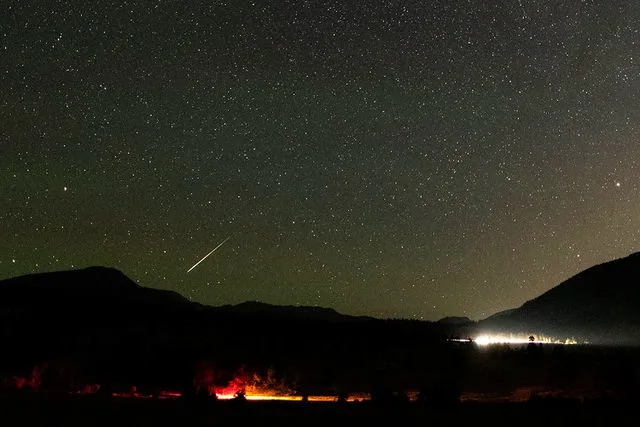
A bright flash that lit up the night sky across parts of British Columbia on Tuesday evening came from a meteor racing through the Earth’s atmosphere, according to experts who reviewed the event.
Residents across several communities reported seeing a sudden streak of light followed by a loud boom shortly after 9 p.m. PT. Scientists later confirmed that the dramatic moment came from a natural meteor known as a “fireball.”
Experts Identify the Object
Robert Lunsford of the American Meteor Society said the event was clearly a fireball. Scientists use this term for meteors that appear brighter and larger than usual.
Lunsford explained that most meteors entering the atmosphere are very small.
“Average meteors are only the size of a pea,” he said.
However, the extreme speed at which these objects travel can make even small fragments appear bright in the night sky.
“A meteor the size of a softball can produce a flash as bright as the full moon and qualify as a fireball,” Lunsford said in an emailed statement. “Therefore, this object was still relatively small, but capable of producing an impressive sight in the sky.”
He added that the quick flash suggested the object was not space debris from human-made satellites. Instead, the object likely consisted of natural material such as stone, metal or a mixture of both.
Evidence From the Atmosphere
Scientists also examined data collected during the event. Meteorologist and science reporter Johanna Wagstaffe said instruments that measure ground movement detected a signal around the time the flash appeared.
Local seismographs recorded a noticeable spike near 9:10 p.m. PT.
Wagstaffe said the loud boom likely came from the object moving extremely fast through the atmosphere. When a meteor travels at high speeds, it compresses the air in front of it and heats the surrounding gases. This process creates a sonic boom.
“These objects travel anywhere from 20 to 70 kilometres per second,” she explained.
Although meteors appear around the world, Wagstaffe noted that sightings in western North America remain relatively rare.
“But it's always a big deal when we can visually experience something falling from space,” she said.
NASA Confirms the Event
Scientists also examined satellite data to understand the meteor’s path.
Officials confirmed that the meteor appeared over the Pacific Northwest shortly after 9 p.m. Tuesday evening.
According to the analysis, the object first became visible about 98 kilometres above Coquitlam, British Columbia.
The meteor travelled slightly east of north at roughly 33 kilometres per second, or about 119,000 kilometres per hour.
Researchers calculated that the object moved across about 71 kilometres of the upper atmosphere before breaking apart. The meteor disintegrated roughly 65 kilometres above Greenmantle Mountain in Garibaldi Provincial Park.
Sightings Across a Wide Area
The glowing fireball did not go unnoticed. Witnesses reported seeing the bright flash across a large portion of the region.
Astronomy professor Brett Gladman from the University of British Columbia said observers spotted the meteor from several locations, including Comox to the west, Merritt to the east and even Seattle, Washington to the south.
Scientists believe the object entered the atmosphere north of Coquitlam and travelled in a northward direction.
Early estimates suggest the meteor came from a rocky asteroid fragment roughly 10 centimetres wide. Some scientists say the fragment may have been larger, possibly up to one metre across.
Gladman explained that the glowing streak seen by observers came from the intense heat created as the rock rushed through the atmosphere.
“The visible meteor is the glowing atmosphere heated by rock's passage and the audible boom is because the speed of the object is faster than the speed of sound (like the supersonic boom related to fast jet planes),” Gladman said.
He added that the meteor likely fell into a mountainous and heavily forested region north of Coquitlam. If any fragments survived the journey to the ground, finding them would prove extremely difficult.
A Rare Moment in the Night Sky
For many residents across British Columbia, the unexpected flash offered a rare and memorable view of space activity from Earth.
Scientists will continue studying reports and satellite data to better understand the event.