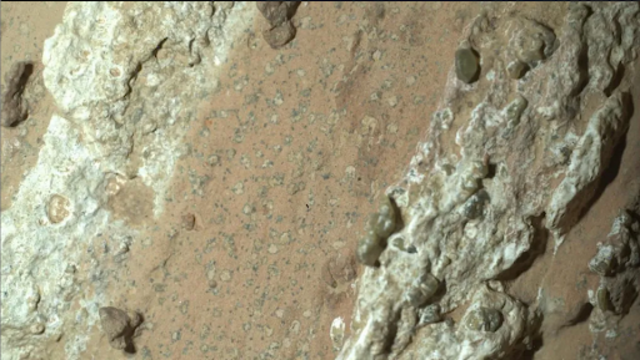
The rocks display strange patterns that resemble the spots on a leopard. NASA
NASA’s Perseverance Rover has uncovered unusual mudstones on Mars that may hold the strongest signs yet of possible past life. The rocks, found in the Jezero Crater, feature striking markings described as “leopard spots” and “poppy seeds.” Scientists say these patterns could point to chemical reactions once linked to microbes.
Potential Signs of Biology
Researchers explained that such minerals often form through microbial activity on Earth. Professor Sanjeev Gupta said, “We’re not saying that we found life, but we’re saying that it really gives us something to chase.” NASA added that these rocks meet the definition of “potential biosignatures,” meaning they deserve close investigation.
NASA Scientists Weigh In
Dr. Nicola Fox compared the discovery to a “leftover fossil” or even “a leftover meal,” stressing how unusual these features are. Dr. Joel Hurowitz explained that the reactions in the rocks seemed to involve mud and organic matter, creating new minerals. He noted that microbes typically drive such processes on Earth.
The Challenge of Proof
The only way to confirm if microbes caused these reactions would be to bring the samples back to Earth. Perseverance has collected and stored several of these rocks. However, NASA’s plans for a Mars sample return face uncertainty due to proposed budget cuts. A similar mission led by China could move ahead in 2028.
What Mars Once Was
Today, Mars is cold and barren, but billions of years ago it had rivers, lakes, and a thicker atmosphere. That environment may have allowed life to develop. The Bright Angel Formation, where Perseverance found these rocks, was once part of a river delta. Scientists estimate the rocks are about 3.5 billion years old.
Why These Rocks Matter
The rover’s instruments revealed chemical changes that could have biological origins. While natural geological processes remain a possible explanation, scientists say they would require conditions unlikely for these rocks. “This feels like the most compelling potential biosignature detection that we’ve had to date,” Dr. Hurowitz said.
Waiting for Answers
For now, the rocks sit sealed inside metal canisters on the Martian surface. Many scientists believe examining them on Earth is essential. “I think for true confidence, most scientists would want to see and examine these rocks on Earth,” said Prof. Gupta.
The discovery marks one of the most exciting steps in the ongoing search for life beyond Earth.