Image credit: NASA
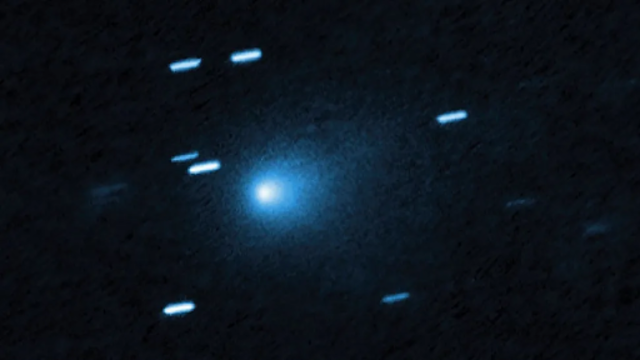
NASA has released the clearest images so far of comet 3I/ATLAS, an interstellar object speeding through our solar system. The new shots, taken by the Hubble Space Telescope, have given scientists a better idea of its size — and it turns out to be smaller than earlier estimates.
Astronomers first spotted 3I/ATLAS on July 1. The very next day, experts confirmed that it came from outside our solar system. The comet is moving at over 130,000 miles per hour (210,000 km/h) and will swing closest to the Sun in late October. It poses no danger to Earth, as it will be on the far side of the Sun at that time.
Mystery Origins and Shape
3I/ATLAS is only the third known interstellar object to pass through our neighborhood. Scientists are still trying to figure out where it came from and what it’s made of.
"No one knows where the comet came from," said David Jewitt, an astronomer leading the Hubble observations. "It’s like glimpsing a rifle bullet for a thousandth of a second."
In late July, the Vera C. Rubin Observatory suggested the comet’s icy center might be about 7 miles (11.2 km) wide. But Hubble’s images now indicate it’s likely no more than 3.5 miles (5.6 km) across. Even at that size, it’s still the largest interstellar object ever seen. NASA says it could be as small as 1,000 feet (320 meters), but more observations — including from the James Webb Space Telescope — should give clearer measurements as it draws nearer.
Only the Third of Its Kind
Before 3I/ATLAS, astronomers had spotted just two interstellar visitors. The first was ‘Oumuamua in 2017, a mysterious, cigar-shaped asteroid about 0.2 miles (0.4 km) wide. The second was Comet Borisov in 2019, with a nucleus about 0.6 miles (1 km) wide. Both are much smaller than the upper size estimates for 3I/ATLAS.
These rare travelers offer valuable clues about other star systems. Each one may carry chemical signatures and materials from its home system, giving researchers insight into planets and debris far beyond our reach.
"Each one of these ISOs is a little piece of low-hanging fruit from a tree that can tell us a great deal about the trees growing in some other neighborhood," said Wes Fraser, an astronomer with the National Research Council of Canada.
A Chance to Learn More
Scientists are racing to study 3I/ATLAS before it leaves our solar system forever. Its speed and distant origin make it an unusual chance to peek into the chemistry and structure of far-off planetary systems. For now, Hubble’s images are the most detailed ever captured of this fast-moving stranger, but even sharper views are expected in the months ahead.