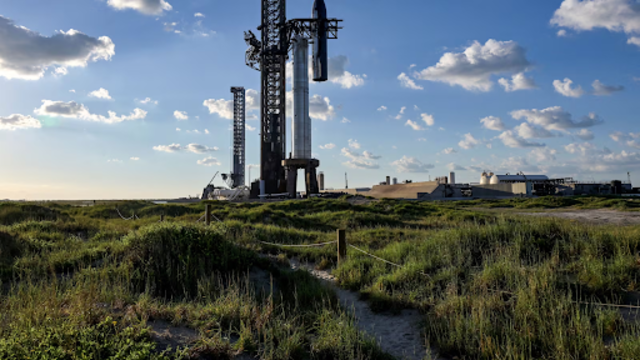
Workers lifted SpaceX’s Starship spacecraft into position on the launch tower at the company’s Starbase site in Texas on October 11, 2025. The towering rocket stood ready for preparations ahead of its next major test flight. CNN
Calls are growing for NASA to send astronauts back to the moon before the decade ends. Lawmakers from both parties and science advocates have voiced strong support. But behind this enthusiasm lies a complicated challenge — and rising competition from China.
NASA plans to rely on SpaceX’s Starship, the largest rocket ever built, for part of its upcoming lunar mission. However, many questions remain about whether the system can perform as expected. At the same time, China’s space agency is racing to land astronauts on the moon within five years.
“This is a turning point,” said Bill Nye, CEO of The Planetary Society. “This is a key point in the history of space exploration.”
Starship Faces Major Hurdles
Starship is still in its testing phase and has faced several failures. Six of its ten test flights have ended in explosions or other problems. SpaceX plans another launch soon from South Texas.
Engineers must also solve complex issues, such as refueling Starship while it orbits Earth — something never done before. NASA’s 2027 moon mission depends on this step. Some estimates suggest SpaceX may need to launch up to 40 refueling tankers for one mission, though others predict closer to 10.
Former NASA administrator Jim Bridenstine said the approach is “extraordinarily complex.” He added that few NASA leaders would have chosen such a design if given a choice.
Acting NASA administrator Sean Duffy defended the decision, saying, “We are going to beat the Chinese to the moon.”
Why Artemis Differs from Apollo
Unlike the Apollo missions, which used one Saturn V rocket, NASA’s Artemis program uses multiple spacecraft. Supply chains for Apollo’s hardware no longer exist, and NASA’s new goal goes beyond planting a flag.
Artemis aims to explore the moon’s south pole — a region thought to contain water ice that could support future moon bases. “For the research we’re going to do, it takes a larger lander,” said former NASA chief Bill Nelson.
Complex Mission Design
Under the current plan, SpaceX will first send up a Starship refueling depot into orbit. Then, several tanker Starships will dock with it to fill it with fuel. Once ready, a crewed Starship — called the Human Landing System — will launch, refuel in orbit, and head to the moon.
At the same time, NASA astronauts will travel aboard the Orion spacecraft on NASA’s SLS rocket. Orion will meet Starship in lunar orbit, and two astronauts will transfer to Starship for the descent to the surface. After a week of exploration, they’ll return to Orion for the trip back to Earth.
If successful, NASA will land humans on the moon by mid-2027 — ahead of China’s 2030 goal.
Debate Over the Plan
Some critics believe NASA’s choice of Starship could delay the mission by years. Others argue the project is too far along to change course. Despite concerns, SpaceX’s history of success gives many officials confidence.
“There is a multifaceted, self-perpetuating genius at SpaceX,” said Paul Hill of NASA’s Aerospace Safety Advisory Panel. “There is no competitor that has this full combination of factors.”