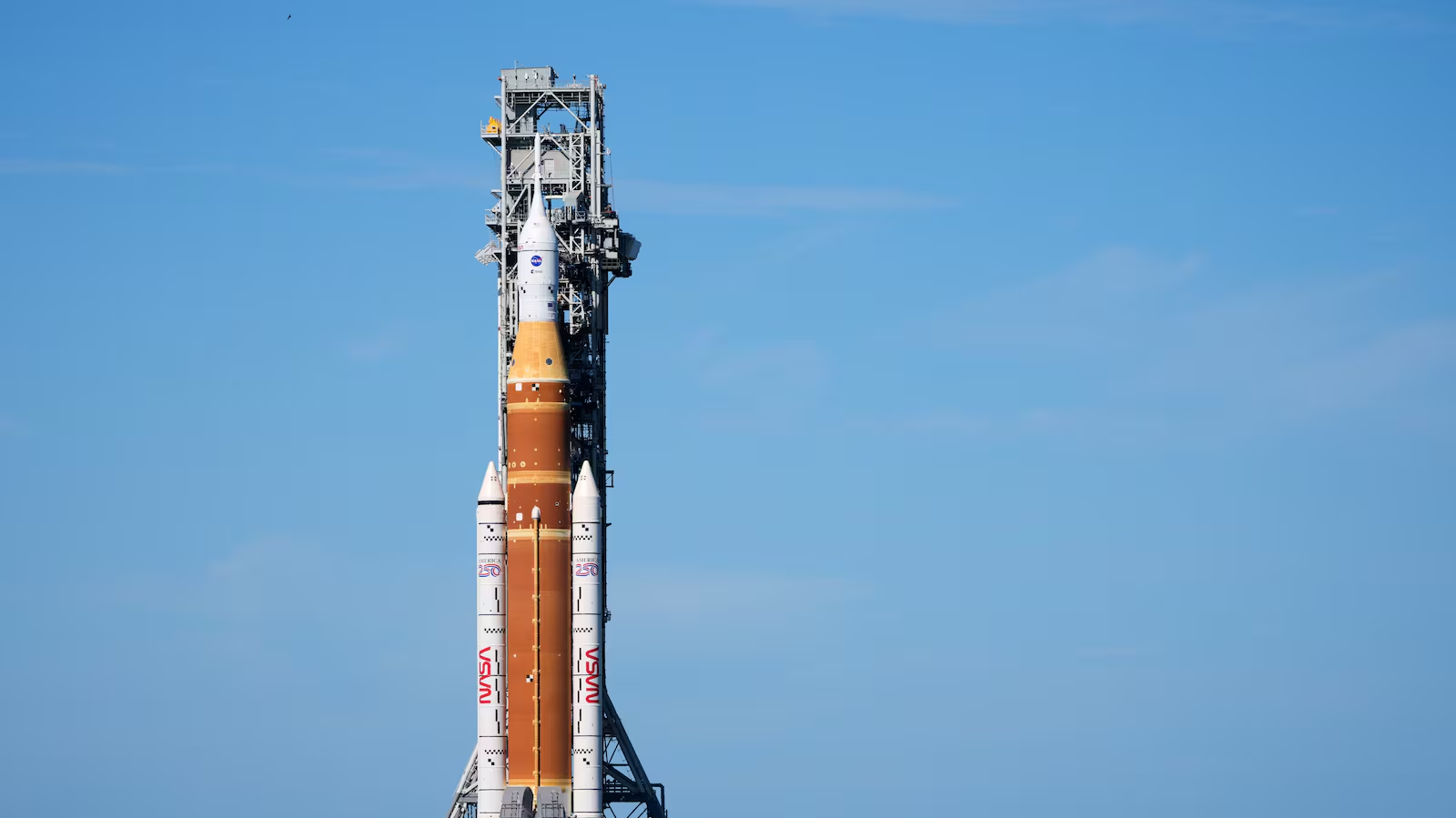
NASA’s Artemis II moon rocket slowly moves toward Launch Pad 39B at the Kennedy Space Center in Cape Canaveral on Saturday, January 17, 2026. AP Photo
NASA has taken a major step toward sending humans back to the Moon by moving its massive Space Launch System rocket and Orion spacecraft to the launch pad. The rollout began Saturday at the Kennedy Space Center in Florida, marking the start of final preparations for the Artemis 2 mission.
The move, which takes up to 12 hours, brings the towering orange-and-white rocket four miles from the Vehicle Assembly Building to Launch Pad 39B. Once in place, engineers will begin a series of tests needed before the mission can lift off.
First Crewed Moon Flight in Over 50 Years
Artemis 2 will become the first crewed mission to the Moon since the Apollo era more than five decades ago. If testing goes as planned, the launch could happen as early as February 6.
The mission will carry three American astronauts and one Canadian. The crew will not land on the Moon but will fly around it and return to Earth after about 10 days in space. The flight will test key systems needed for future landings.
“This is a huge moment,” said John Honeycutt during a news briefing. “We’re making history.”
Astronauts Watch the Rocket Roll Out
The Artemis 2 crew attended the rollout in person. The team includes American astronauts Reid Wiseman, Victor Glover, and Christina Koch, along with Canadian astronaut Jeremy Hansen.
Hansen said the sight of the rocket made the mission feel real. “I’m actually pretty pumped to see that,” he told reporters. “In just a few weeks, you’re going to see four humans fly around the moon, and if we’re doing that now, imagine what we can do next.”
Glover echoed the excitement. “We’re swinging for the fence, trying to make the impossible possible,” he said.
Testing Comes Before Takeoff
Before launch, teams must confirm that the Space Launch System is safe and ready. Engineers will run a full set of checks and simulations, including a practice countdown, to ensure all systems work as expected.
NASA last tested the rocket during the uncrewed Artemis 1 mission in November 2022. That mission faced delays and two failed launch attempts before finally lifting off.
Space Race Pressures Build
NASA hopes Artemis 2 will move the United States closer to returning astronauts to the lunar surface, a goal first announced during Donald Trump’s first term.
The push comes as China accelerates its own Moon plans. China aims to send astronauts to the Moon by 2030 and plans to launch its Chang’e 7 mission in 2026 to explore the lunar south pole.
NASA also views the Moon as a training ground for future missions to Mars. Still, the Artemis program has faced repeated delays. While Artemis 2 moved up, experts expect Artemis 3, now planned for 2027, to slip because of delays in developing the landing spacecraft.