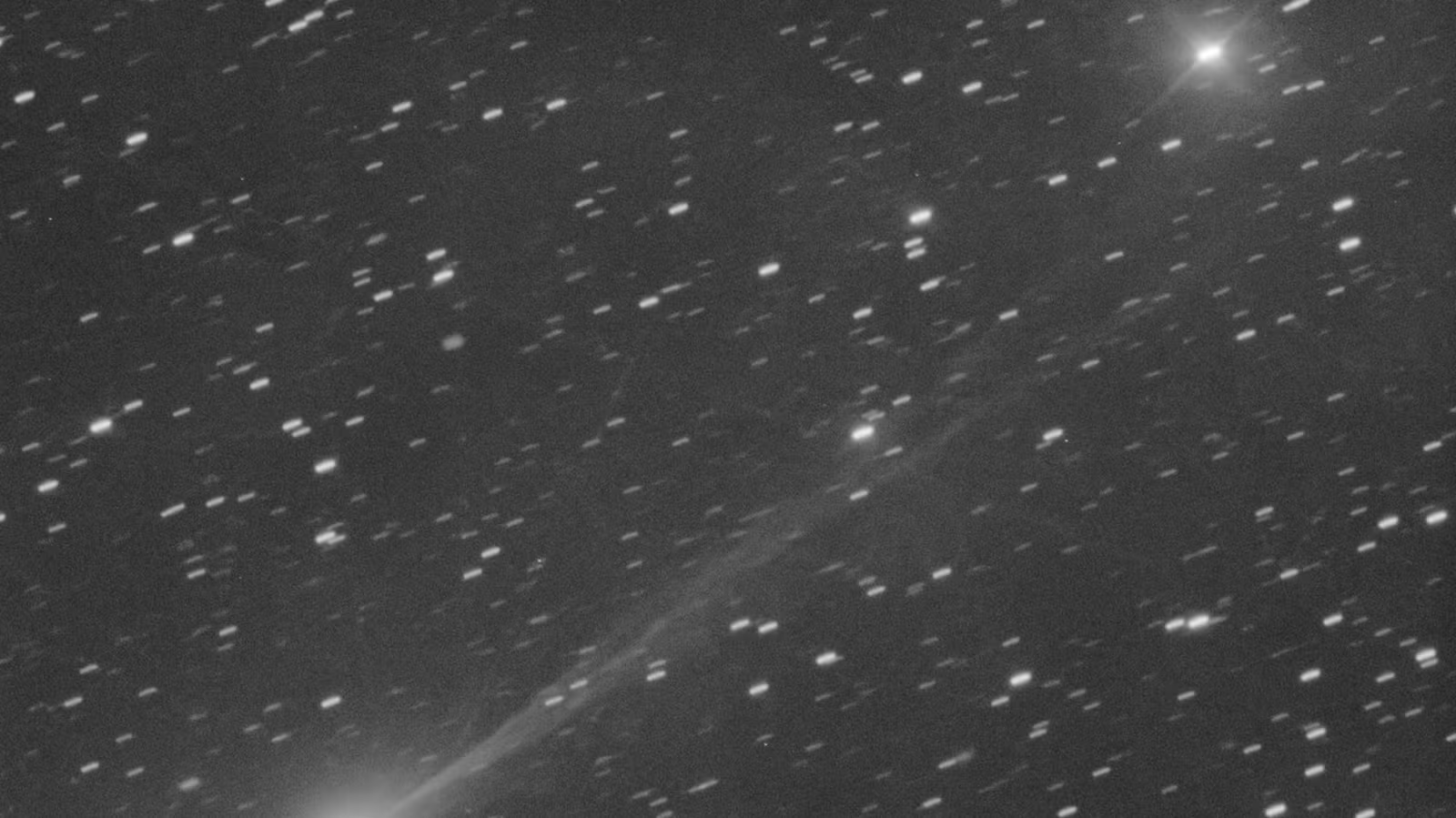
This photo by Gianluca Masi shows the interstellar comet 3I/Atlas travelling through space about 190 million miles from Earth on Wednesday, Nov. 19, 2025. The image was captured from Manciano, Italy. NASA
NASA shared new close-up images on Wednesday of a comet that arrived in our solar system from another star. The comet, named 3I/Atlas, will swing through once and never return. Scientists discovered it earlier this summer, and it recently passed by Mars on its brief journey.
This is only the third confirmed interstellar object ever spotted near our solar system, making the event a rare moment for astronomers everywhere.
Spacecraft Capture Rare Images
Three NASA spacecraft orbiting or flying near Mars focused their cameras on the comet as it travelled just 18 million miles from the red planet last month. The images showed a glowing, fuzzy white shape against deep space.
Two satellites from the European Space Agency also studied the comet during its flyby.
NASA says more spacecraft will continue observing the comet, including the Webb Space Telescope. Astronomers on Earth are using ground telescopes as well. Gianluca Masi of the Virtual Telescope Project zoomed in from Italy on Wednesday.
The comet now sits about 190 million miles from Earth. People can spot it in the early morning sky with binoculars or a telescope.
“Everyone that is in control of a telescope wants to look at it because it’s a fascinating and rare opportunity,” said NASA’s acting astrophysics director, Shawn Domagal-Goldman.
No Return Trip for 3I/Atlas
The comet will make its closest approach to Earth in mid-December at 167 million miles. After that, it will head back into interstellar space, never to be seen again.
ESA’s Juice spacecraft, which is on its way to Jupiter, has been studying the comet during the past month. But the data won’t arrive until February because Juice’s main antenna currently protects the spacecraft from the sun, slowing down communication.
A Glimpse Into the Ancient Universe
Astronomers believe 3I/Atlas measures somewhere between 440 metres and 5.6 kilometres across. Early data suggests the comet may come from a star system older than our own.
NASA scientist Tom Statler said the comet gives experts a rare look into the distant past. “That means that 3I/Atlas is not just a window into another solar system, it's a window into the deep past … so deep in the past that it predates even the formation of our Earth and our sun,” he said.
NASA Sets the Record Straight
As online rumours spread, NASA stressed that the comet is not an alien spacecraft. Officials said the government shutdown made it harder to address the claims as they appeared.
NASA’s associate administrator Amit Kshatriya added that while the agency always searches for signs of life in the universe, “3I/Atlas is a comet.”