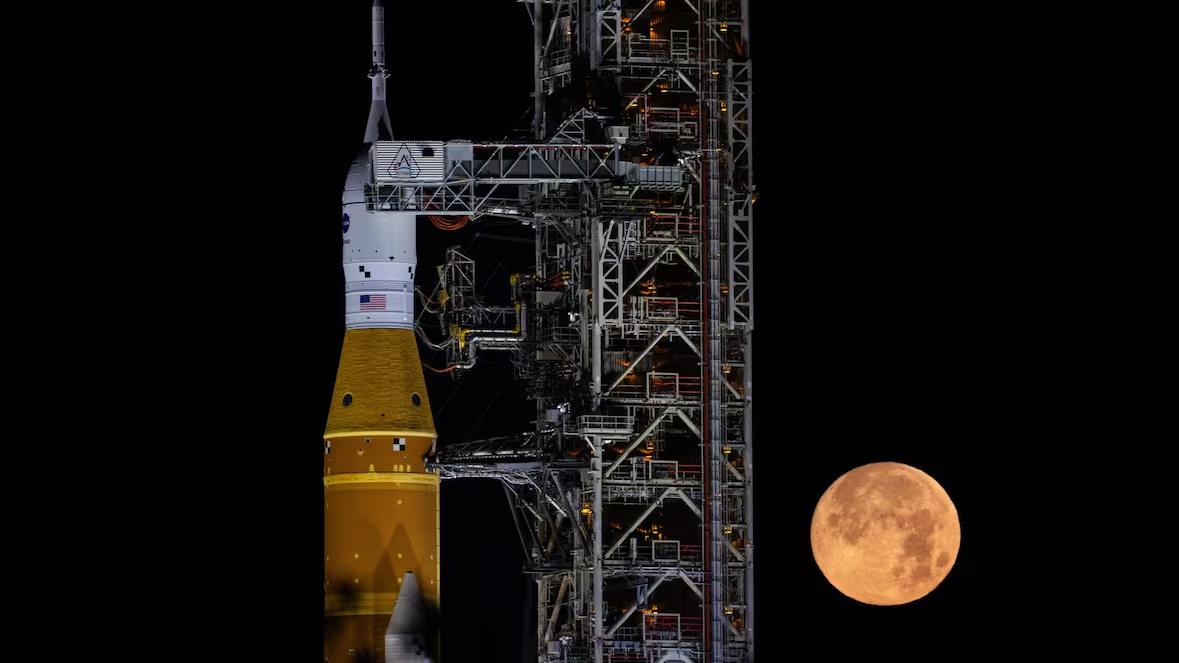
A bright full moon lights up NASA’s Space Launch System rocket and Orion spacecraft as they stand on the mobile launcher in the early morning of Feb. 1, 2026. NASA
NASA has taken an important step toward sending astronauts back around the moon. The space agency successfully completed its second full launch rehearsal for the Artemis II mission, clearing a major hurdle ahead of a planned March liftoff.
The rehearsal simulated nearly every step of launch day. Teams counted down the clock twice to just past T-minus 30 seconds. At that point, the rocket would have lifted off in less than a minute.
Artemis II will carry four astronauts on a mission around the moon: Canadian Space Agency astronaut Jeremy Hansen and NASA astronauts Reid Wiseman, Christina Koch and Victor Glover.
Hydrogen Issue Finally Resolved
Previous rehearsals faced repeated setbacks due to hydrogen leaks during fuelling. Liquid hydrogen powers the rocket, but it presents challenges. Hydrogen molecules are extremely small, making them difficult to contain.
The first Artemis II wet dress rehearsal began on Jan. 31 and ran until Feb. 3. Engineers detected a hydrogen leak during fuelling, forcing them to pause operations. A similar problem occurred during the earlier Artemis I mission.
During Thursday’s rehearsal, teams successfully loaded both the core stage and upper stage of the rocket with liquid hydrogen and liquid oxygen. The fuelling process begins slowly before switching to a faster fill.
In past attempts, hydrogen levels exceeded safety limits. This time, officials reported that leak levels stayed within acceptable ground safety thresholds.
"This marks an important milestone in the test, as teams reached this step without exceeding the ground safety limit of the hydrogen leak concentration, as was observed during the first Artemis II wet dress rehearsal," NASA said in its Artemis blog Thursday afternoon.
The second stage of the rocket also showed no issues.
Minor Communication Glitch
Engineers noted a brief ground communication issue during the rehearsal. However, teams resolved it quickly, and it did not prevent the test from meeting its objectives.
The successful fuelling marks the most significant progress toward the mission’s launch readiness.
A Long Road to This Moment
NASA’s Space Launch System rocket has faced years of delays. Development challenges postponed the uncrewed Artemis I mission, which eventually launched in November 2022 after multiple test attempts and technical adjustments.
In early 2022, Artemis I rehearsals stalled due to nitrogen tank concerns and hydrogen leaks. Engineers rolled the rocket back to the Vehicle Assembly Building for repairs and upgrades before it finally lifted off on Nov. 16, 2022.
After the first Artemis II rehearsal encountered similar issues earlier this year, NASA made additional modifications to prevent further hydrogen leaks. The latest test suggests those improvements worked.
What Artemis II Will Do
Artemis II will send the four astronauts on a journey around the moon. The crew will test the Orion spacecraft’s systems and conduct experiments during the mission.
The flight serves as preparation for Artemis III, which aims to land astronauts on the lunar surface. That mission is currently scheduled for no earlier than 2028.
NASA plans to hold a press conference to discuss the rehearsal results and next steps.
For now, officials say the next available launch window opens in early March.
After years of testing, delays and adjustments, NASA appears closer than ever to returning astronauts to deep space — with a Canadian astronaut playing a key role in the journey.