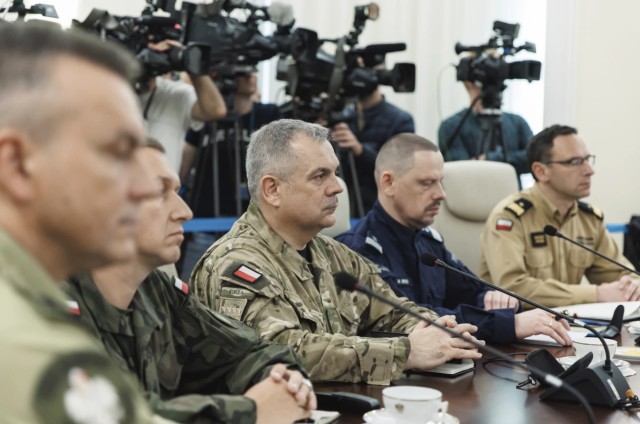
General Wieslaw Kukula, center, chief of the General Staff of the Polish Armed Forces during at the Chancellery of the Prime Minister for an extraordinary government meeting, following violations of Polish airspace during a Russian attack. in Warsaw, Poland, Wednesday, Sept. 10, 2025.
NATO allies convened urgent talks after multiple Russian drones breached Polish airspace this week. Fighter jets from Poland and the Netherlands intercepted and shot down several of the drones, raising fresh concerns over security within the alliance.
Polish Prime Minister Donald Tusk told Parliament that the consultations took place under NATO’s Article 4. The talks were held during the regular meeting of the North Atlantic Council, which represents all 32 member states. The incident followed Russia’s largest aerial assault on Ukraine since the war began.
What NATO Article 4 Means
Article 4 is among the shortest provisions of NATO’s founding treaty of 1949. It states that members must consult whenever the security, political independence, or territorial integrity of any ally is threatened.
Experts note that this article serves as a mechanism for immediate dialogue. It does not obligate allies to take military action but ensures threats are formally addressed.
Bob Deen, an analyst at the Clingendael think tank in The Hague, explained that Article 4 fosters coordination and strengthens awareness among allies. It gives members the right to bring urgent matters directly to the agenda of the North Atlantic Council.
Poland’s History With Article 4
This is not Poland’s first use of Article 4. Warsaw has previously requested such consultations during critical moments in Russia’s conflict with Ukraine.
In March 2014, Poland invoked Article 4 after Russia’s annexation of Crimea. Again, in February 2022, Poland joined seven other allies—including the Baltic states, Romania, Bulgaria, Czechia, and Slovakia—in requesting talks after Russia launched its full-scale invasion of Ukraine.
These examples highlight how Poland frequently turns to NATO’s consultative mechanism when tensions rise near its borders.
How Often Article 4 Is Invoked
Article 4 is used relatively rarely, but its frequency has increased in recent years.
Between 2003 and 2020, Turkey invoked Article 4 five times, largely in connection with conflicts in Syria and Iraq. In 2022, eight NATO allies invoked it shortly after Russia’s invasion of Ukraine.
This growing reliance reflects rising security threats on NATO’s eastern flank, especially with Russia’s military aggression destabilizing the region.
Article 4 vs. Article 5: The Key Difference
A common misconception is that Article 4 automatically leads to Article 5, NATO’s collective defense clause. That is not the case.
Article 5 ensures that an attack on one ally is considered an attack on all. It has only been triggered once, after the September 11 attacks in the United States. Notably, that decision bypassed Article 4 entirely.
According to Deen, Article 4 is not a “stepping stone” to Article 5. It is a consultation tool that may, or may not, lead to further collective measures depending on the situation.
Why This Incident Matters for NATO
The breach of Polish airspace underscores how Russia’s war in Ukraine continues to spill beyond Ukrainian borders. Even without direct strikes on NATO territory, drone incursions raise the risk of miscalculation or escalation.
By invoking Article 4, Poland ensures that its concerns are discussed at the highest NATO level. While this does not guarantee military action, it demonstrates solidarity and keeps pressure on the alliance to monitor threats closely.
For NATO, every Article 4 consultation is a reminder of the fragile security balance in Eastern Europe. With Russia escalating its attacks, such discussions may become increasingly common in the months ahead.