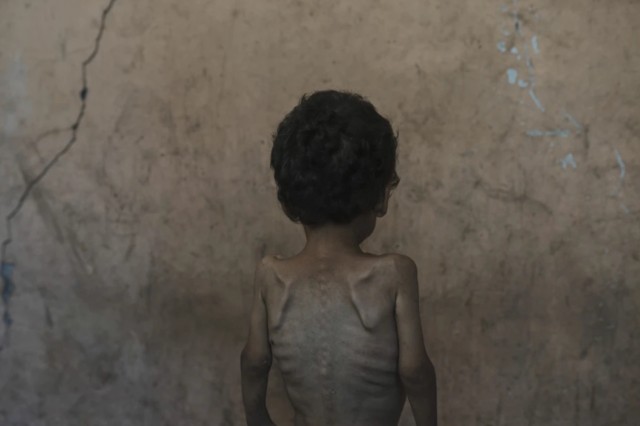
Yazan Abu Ful, a 2-year-old malnourished child, poses for a photo at his family home in the Shati refugee camp, in Gaza City on Wednesday, July 23, 2025.
Israeli Prime Minister Benjamin Netanyahu recently claimed, “There is no starvation in Gaza.” But global experts, aid workers, and disturbing images from the ground paint a very different picture. As Gaza reels from war, its people face worsening hunger, rising death tolls, and a growing outcry for humanitarian access.
Netanyahu's Denial Faces Global Rebuttal
Speaking publicly, Netanyahu insisted that Israel is not using hunger as a weapon in Gaza. He argued that humanitarian aid has been allowed in and stated, “Otherwise, there would be no Gazans.”
However, former U.S. President Donald Trump openly contradicted Netanyahu’s remarks. “Those children look very hungry,” Trump said, referring to emaciated visuals of Gaza’s youth circulating worldwide.
Aid Arrives, But Real Relief Lags Behind
Under international pressure, Israel announced limited humanitarian pauses and food airdrops last weekend. Yet residents in Gaza report no meaningful change. The UN described it as a one-week aid scale-up but questioned its duration and effectiveness.
Witnesses say chaos often breaks out during these airdrops. Hasan Al-Zalaan, who saw one firsthand, described people fighting over food. “This aid, delivered like this, is an insult to the Palestinian people,” he said.
Hunger-Linked Deaths On The Rise
According to the World Health Organization (WHO), 63 people — including 24 children under five — have died from malnutrition-related causes in July alone. That’s nearly six times higher than in previous months.
Gaza’s Health Ministry, operated by local medical professionals and considered reliable by the UN, reports even higher figures: 82 deaths this month, including 58 adults. Fourteen of those deaths occurred in just one day.
Hospitals are overwhelmed. Doctors say that, for the first time, even healthy children have died from starvation. Adults with chronic illnesses like diabetes, heart disease, or kidney disease are succumbing faster due to the lack of food and medical care.

Palestinians struggle to get donated food at a community kitchen, in Gaza City, northern Gaza Strip, Saturday, July 26, 2025.
Malnutrition Skyrockets Across Gaza
The WHO notes that acute malnutrition among children under five has tripled in northern Gaza. Nearly one in five now suffers from severe hunger. In central and southern Gaza, the numbers have doubled.
All four specialized malnutrition treatment centers in Gaza are overrun. Staff members report severe shortages of supplies and mounting casualties.
Despite months of warning, the Integrated Food Security Phase Classification — the world’s leading food crisis monitor — has not officially declared a famine. The reason: lack of access to reliable data, blocked by Israeli restrictions.
Trucks Blocked, Airdrops Fall Short
To support aid delivery, Israel announced daily 10-hour humanitarian pauses in three key areas. However, this effort has not significantly improved distribution.
A UN World Food Program official revealed that 55 trucks carrying aid were looted on Monday before reaching their destinations. Hungry people stormed the convoys, desperate for food. Experts say airdrops — though dramatic — are too few and often dangerous for people on the ground.
Israel reported 48 food packages dropped over two days — an inadequate figure given Gaza’s immense need.
Israel Urged to Restore UN Aid Channels
Many Palestinians call for a return to the UN-led aid distribution system used earlier in the war. Since May, Israel has backed a different model, which locals and experts claim is less effective.
Tragically, several Palestinians have died trying to access aid. Witnesses accuse Israeli forces of opening fire on civilians approaching food trucks or aid hubs. Israel denies targeting aid-seekers, saying it only fires warning shots.
Delivering Aid Faces Roadblocks
The UN has consistently called on Israel to loosen restrictions. A single truck can carry 19 tons of supplies — a critical resource. But on average, only 146 trucks per day enter Gaza, far below the 500–600 needed.
Since the war began, Israel claims 95,435 trucks have entered Gaza. Yet, over half of the UN’s movement requests for trucks have been denied or delayed in the past three months.
Once aid crosses the border, it sits idle without permission to move forward. And when it does move, convoys are often swarmed by desperate civilians or armed groups.
Gaza's Hunger Crisis Grows More Urgent
The humanitarian crisis in Gaza is intensifying. Aid trickles in, but many on the ground say it's too little, too late. While Israeli officials deny starvation, the evidence from hospitals, aid workers, and families tells another story — one of mounting hunger, desperation, and loss.
Unless access improves and aid flows freely, the hunger crisis in Gaza risks spiralling into full-scale famine.