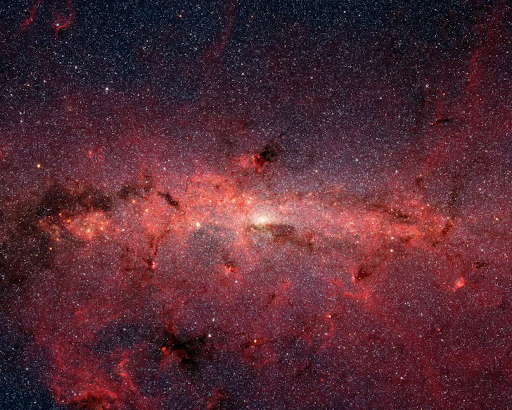
Prof. Totani says gamma rays coming from the centre of the Milky Way seem to show signs of dark matter. Photograph: NASA.
Scientists first suggested the idea of dark matter almost 100 years ago. They believed an unseen material surrounded galaxies and shaped the giant web of matter across the universe. The idea grew after astronomers noticed galaxies spinning faster than they should based on their visible mass. This unseen force soon became known as dark matter.
Researchers still debate what dark matter is made of—or if it exists at all. But a new study offers what one scientist calls the first possible “direct evidence” of the mysterious substance.
A Possible Breakthrough
Prof. Tomonori Totani of the University of Tokyo says gamma rays coming from the centre of the Milky Way may show signs of dark matter. He believes the pattern of this radiation could match predictions of how dark matter behaves. If true, the finding could mark a major step forward in the decades-long search for answers.
“This could be a crucial breakthrough in unravelling the nature of dark matter,” Totani said. His work appears in the Journal of Cosmology and Astroparticle Physics.
Dark matter makes up roughly 27 per cent of the universe, according to current models. Yet no one has caught it directly, and no detector on Earth or in space has confirmed the particles behind it.
Searching for Signals
One leading theory suggests dark matter consists of “weakly interacting massive particles,” often called wimps. These particles would be heavier than protons inside atoms, but they would barely interact with normal matter. Scientists say that when two wimps meet, they could destroy each other, releasing energy and gamma rays.
Totani used data from NASA’s Fermi Gamma-ray Space Telescope to look for these signals. The telescope captures the most energetic light in the universe. After studying the observations, Totani noticed a gamma-ray pattern that stretched outward from the galaxy’s centre in a sphere-like shape. He said this shape resembled the dark matter “halo” predicted by many models.
The signal, he says, “closely matches the properties of gamma-ray radiation predicted to be emitted by dark matter.”
Experts Urge Caution
Other scientists say the finding is interesting but far from proven. They warn that many other cosmic processes create gamma rays, and more study is needed before drawing firm conclusions.
Totani believes the next step is to search for identical signals from other regions, such as dwarf galaxies. These small galaxies are key testing grounds because they contain lots of dark matter but very little background noise. So far, though, studies of dwarf galaxies have shown no strong signs of dark matter activity.
Prof. Justin Read from the University of Surrey noted this problem. He said the lack of clear signals from dwarf galaxies “strongly argues against” the idea that Totani has detected dark matter.
Prof. Kinwah Wu of University College London also urged patience. He said the work is promising but not final. “We need extraordinary evidence for an extraordinary claim,” he said. He called the study a useful step but said it falls short of a confirmed discovery.
What Comes Next
The search for dark matter continues, with researchers around the world studying everything from cosmic rays to underground detectors. Totani’s findings renew interest in the Milky Way’s centre, an area long suspected to hold important clues.
For now, scientists agree on one thing: if dark matter has finally shown itself, the discovery would mark a major turning point in modern astrophysics. But until further evidence appears, the mystery continues.