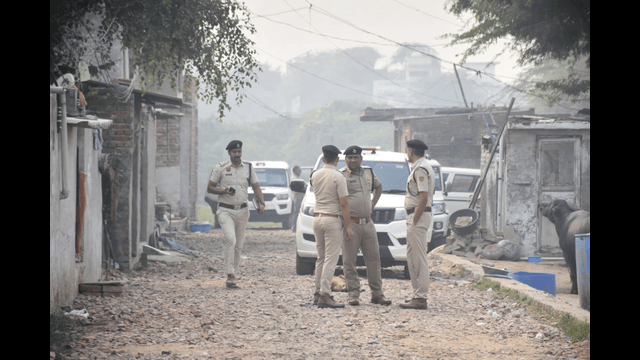
Security officials stand outside a house at Fatehpur Tagga, in Faridabad on the outskirts of New Delhi, India, Monday, Nov. 10, 2025.
India’s anti-terror agency has arrested a key suspect linked to the New Delhi car blast that killed ten people last Monday. The attack, which injured 32 others near the historic Red Fort, has sparked one of the country’s largest recent counterterror investigations.
Breakthrough in the New Delhi Car Blast Case
The National Investigating Agency (NIA) announced the arrest of Amir Rashid Ali, a resident of Indian-controlled Kashmir. Officials said he allegedly conspired with the suicide bomber and helped procure the vehicle used in the New Delhi car blast.
The NIA described the arrest as a “major breakthrough,” suggesting Ali’s involvement was central to the planning and execution of the attack.
Blast Near Red Fort Triggers National Outrage
The explosion occurred on a busy stretch near Red Fort, a major landmark in the capital. The powerful blast killed ten people instantly and left dozens wounded.
Authorities labeled the New Delhi car blast a “heinous terror incident” carried out by “anti-national forces,” prompting heightened security across the city.
Suicide Bomber Identified as Kashmiri Doctor
Investigators identified the suicide bomber as Umar Un Nabi, a Kashmiri doctor who taught at a medical college in Faridabad, on the outskirts of Delhi.
Officials said government forces demolished his family home in Pulwama district on Thursday night in what they called a retaliatory action.
Linked Crackdown in Kashmir
Hours before the New Delhi car blast, Kashmir police announced they had dismantled a suspected militant module operating from the region.
At least seven people, including two Kashmiri doctors working in Indian cities, were arrested. Police seized a “large quantity” of explosives and bomb-making materials from the group.
This raid is now believed to be connected to the Delhi attack, tightening the investigative focus on radical networks extending beyond Kashmir.
Nationwide Raids and Mass Questioning
Following the blast, Indian security forces launched widespread operations across the Kashmir Valley. Thousands of people were questioned as agencies searched for additional suspects, financial links, and logistical support behind the New Delhi car blast.
Hundreds were detained as part of the probe, reflecting the scale of the suspected network.
Tragedy at Srinagar Police Station
In another twist to the unfolding investigation, explosives seized from Faridabad and transported to Srinagar detonated accidentally inside a police station on Friday night.
The blast killed at least nine people and injured 32 others, adding to the week’s mounting casualties.
Officials stated the explosion occurred during inspection and storage procedures, raising concerns over handling protocols for confiscated weapons and explosives.
Rising Concerns Over Expanding Militant Networks
The New Delhi car blast has renewed attention on expanding terror modules with possible ties across multiple Indian states. Authorities believe the involvement of educated professionals—including doctors—signals a concerning evolution in recruitment patterns.
With the investigation still expanding, agencies remain on high alert. New Delhi and major cities have strengthened security around government buildings, transport hubs, and public spaces.
What Comes Next
The arrest of Amir Rashid Ali marks a significant step, but the probe continues to widen. Investigators are tracing communication records, financial trails, and cross-border links to fully map the network behind the New Delhi car blast.
As families mourn and the nation demands answers, authorities aim to dismantle the entire network responsible for the deadly attack, ensuring no further threats emerge from the same group.