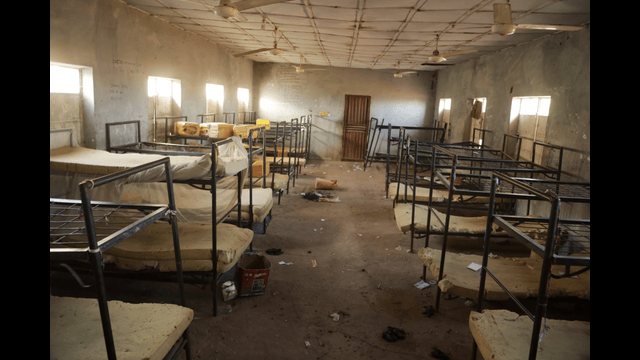
The dormitories where the gunman kidnapped school children are seen in Kebbi, Nigeria, Nov 17, 2025.
Gunmen stormed a boarding school in northwestern Nigeria before dawn on Monday, abducting 25 schoolgirls and killing a staff member in the latest attack to rattle the region. The incident has once again highlighted Nigeria’s worsening kidnapping crisis, which continues to endanger students, communities, and security forces.
A Predawn Attack Shocks Kebbi State
The attack occurred at 4 a.m. in Maga, located in Kebbi’s Danko-Wasagu area. Police spokesperson Nafi’u Abubakar Kotarkoshi confirmed that armed men broke into the dormitories and seized the girls after exchanging gunfire with the school’s guards.
The assailants arrived on multiple motorcycles and carried what officials described as “sophisticated weapons.”
One school staffer was killed during the raid, while another person was injured. A resident, Abdulkarim Abdullahi Maga, whose daughter and granddaughter were kidnapped, believes the death toll may be higher. He said the attackers targeted the teacher’s residence first before killing a guard and heading toward the dormitory.
Search and Rescue Operations Underway
Security agencies have launched a joint search and rescue mission, sweeping through suspected escape routes and forests surrounding the region. The police say the goal is to rescue the abducted schoolgirls and arrest the perpetrators.
Authorities have not identified which group carried out the attack. No organization has claimed responsibility so far.
Bandits Fuel a Growing Kidnapping Industry
Nigeria continues to face a serious security challenge involving loosely organized “bandit” groups that operate throughout the northern region. These groups frequently abduct civilians—especially students—to demand ransoms that can run into thousands of dollars.
Unlike Boko Haram or the Islamic State West Africa Province, these bandits are not driven by religion. Instead, they carry out kidnappings, road ambushes, and attacks on villages for profit and territorial control. Their operations thrive in areas with limited security presence and difficult terrain.
A Grim Pattern Since the Chibok Abductions
The kidnapping crisis in Nigeria’s schools escalated in 2014, when Boko Haram abducted 276 girls from Chibok in Borno State. That incident shocked the world and marked the beginning of widespread student abductions across northern Nigeria.
Since then, more than 1,500 students have been kidnapped by various armed groups. Many captives are used for ransom negotiations, and others are held to intimidate communities or disrupt education in vulnerable regions.
One major rescue operation occurred in March 2024, when over 130 children were freed after being held for more than two weeks in Kaduna State.
Security Measures Have Helped — But Not Enough
State governments have attempted to curb the attacks by upgrading school security and shutting down high-risk schools for extended periods. These measures have helped reduce the frequency of mass abductions.
However, Monday’s attack in Kebbi shows that armed groups still pose a powerful threat, especially in remote areas where state presence is weak.
The Urgent Need for Protection
Families of the abducted girls are pleading for their safe return as communities grapple with fear and uncertainty. The fresh kidnapping underscores the urgent need for stronger protection of schools, better intelligence gathering, and coordinated action against armed groups in northwest Nigeria.
For now, hopes hinge on the ongoing rescue mission, as the nation awaits news of the 25 schoolgirls abducted in Kebbi and prays for their safe recovery.