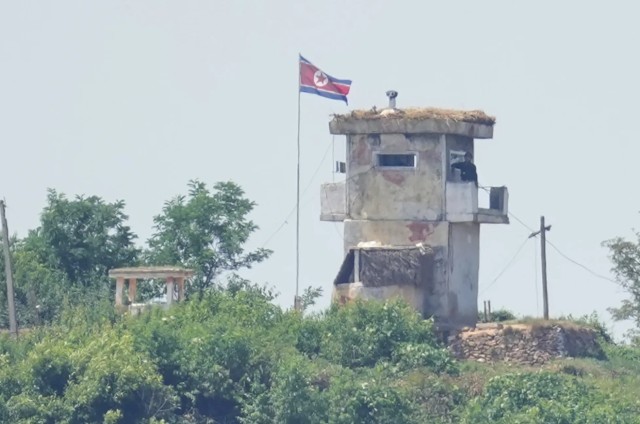
A soldier stands at a North Korean military guard post flying a national flag, seen from Paju, South Korea, June 26, 2024.
North Korea has accused South Korea of a “serious provocation” following warning shots fired at the tense border. The accusation comes amid escalating hostility and military drills between Seoul and Washington.
Border Clash Sparks Fresh Tensions
On Saturday, Ko Jong Chol, vice chief of the North Korean People’s Army’s General Staff, issued a strong statement. He condemned South Korea for deliberately raising tensions while U.S.-South Korea joint military drills were underway.
The controversy began on Tuesday when South Korean troops fired warning shots. They claimed that North Korean soldiers had briefly crossed the military demarcation line while working near the central border. Seoul’s military later confirmed the incident, stating that the soldiers quickly retreated without further confrontation. Importantly, North Korea did not return fire.
Warning Shots Becoming Frequent at Border
This is not an isolated incident. In recent months, South Korea has used loudspeaker warnings and occasional warning shots to drive back North Korean troops. Most encounters happened when North Korean soldiers, engaged in construction work, crossed the border unintentionally.
According to Seoul, North Korean soldiers have been installing anti-tank barriers, planting mines, and strengthening fortifications. These activities are being carried out as part of Pyongyang’s larger strategy to reinforce defenses at the heavily militarized border.
Ko, however, insisted the North’s work was a “barrier project to permanently block the southern border.” He claimed it was part of a broader effort to “completely separate” the two Koreas. He also stressed that North Korea had already informed U.S. forces about these activities on June 25 and July 18 to prevent accidental clashes.
North’s Strong Rebuke to Seoul
In his statement, Ko accused Seoul of intentionally provoking the North. “I strongly demand the South immediately stop these dangerous provocations,” he said. He argued that the warning shots were an excuse to escalate tension while North Korea carried out a sovereignty-driven project.
Ko framed the construction efforts as defensive measures. He said the North was simply fortifying its territory, not seeking conflict. His remarks underline Pyongyang’s stance that South Korea is to blame for rising hostility.
Kim Jong Un’s Hardening Stance
This episode highlights the worsening animosity between the two Koreas. North Korean leader Kim Jong Un has openly abandoned hopes of peaceful unification. Last year, he ordered the rewriting of the North’s constitution to designate South Korea as a “permanent enemy.”
Kim’s position has hardened further due to expanding South Korea-U.S. military drills. He also blamed previous conservative administrations in Seoul for fueling tensions. Meanwhile, Pyongyang has been showcasing its nuclear arsenal and aligning more closely with Russia amid the Ukraine war.
Seoul’s Call for Dialogue
Despite the rising hostility, South Korea’s new liberal president, Lee Jae Myung, has called for dialogue. He recently announced Seoul’s intention to revive the 2018 inter-Korean military agreement aimed at reducing border conflicts.
President Lee urged Pyongyang to rebuild trust and resume communication. However, North Korea has so far dismissed these diplomatic overtures. Instead, it has continued military activities near the border while rejecting reconciliation efforts.
Outlook: Border Tensions Likely to Rise
The latest incident underlines the fragile state of inter-Korean relations. With North Korea pushing for permanent separation and South Korea seeking dialogue, the divide is deepening.
As long as Pyongyang continues fortifying its border and Seoul responds with warning shots, chances of accidental clashes remain high. The situation underscores the urgent need for renewed talks to avoid further escalation.