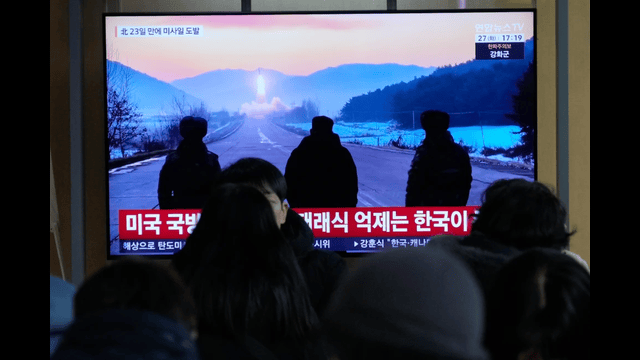
A TV screen shows a file image of North Korea’s missile launch during a news program at Seoul Railway Station in Seoul, South Korea.
North Korea fired suspected ballistic missiles toward the sea on Tuesday, regional officials said.
The launch heightened tensions on the Korean Peninsula amid worsening relations with South Korea.
Japan and South Korea quickly detected the activity.
Both countries confirmed possible missile launches but shared limited technical details.
Neighbors Detect Missile Activity
Japan’s Prime Minister’s Office and Defense Ministry reported the firing of possible ballistic missiles.
South Korea’s Defense Ministry said at least one unidentified projectile was detected.
The projectile was launched from North Korea’s east coast.
Neither country disclosed the missile’s range or exact flight path.
Military officials said further analysis was underway.
The lack of details suggested early-stage assessments.
Background of Rising Hostility
The missile activity followed recent threats from Pyongyang against Seoul.
North Korea accused South Korea of flying surveillance drones across the border.
According to the North, drone flights occurred in January and September.
South Korea denied conducting any such operations.
Seoul said it was investigating whether civilian groups sent the drones.
Officials stressed no military involvement during the stated periods.
Political Timing Raises Concerns
Analysts believe the accusations serve a political purpose.
North Korea is preparing for a major ruling party meeting.
The Workers’ Party congress is expected in late January or February.
It will be the first such congress in five years.
Experts say Pyongyang often escalates rhetoric before key political events.
This strategy helps consolidate internal unity and external pressure.
Possible Constitutional Shift
During the congress, North Korea may introduce major policy changes.
One proposal could redefine relations with South Korea.
Leader Kim Jong Un has declared a hostile “two-state” system.
This approach treats the Koreas as permanent adversaries.
Analysts say this stance could be added to the party constitution.
Such a move would formalize a hardline policy shift.
Focus on Advanced Weapons
North Korea has intensified weapons testing in recent months.
Earlier this month, it claimed successful hypersonic missile test flights.
State media said Kim Jong Un personally observed the launches.
He emphasized strengthening the country’s nuclear deterrent.
Hypersonic missiles are harder to track and intercept.
Their development alarms regional and global security officials.
December Tests Add to Alarm
In December, North Korea test-fired long-range strategic cruise missiles.
It also launched newly developed anti-air missiles.
State media released images of advanced weapons systems.
Photos also suggested construction of a nuclear-powered submarine.
If confirmed, such a submarine would mark a major capability leap.
It could enhance North Korea’s second-strike nuclear potential.
Message Ahead of Party Congress
Analysts say the missile launches send a clear signal.
Pyongyang aims to showcase military achievements before the congress.
Weapons demonstrations often precede policy announcements.
They reinforce the leadership’s narrative of strength and self-reliance.
The timing suggests both domestic and international messaging.
North Korea seeks leverage amid stalled diplomacy.
Regional and Global Reactions
South Korea and Japan remain on heightened alert.
Both countries coordinate closely with the United States.
Officials warn that repeated missile tests undermine regional stability.
They also violate multiple United Nations Security Council resolutions.
Despite condemnation, North Korea shows no sign of slowing tests.
The launches reflect a sustained push for strategic dominance.
As the party congress approaches, further developments are likely.
Observers expect continued missile activity and strong political messaging.