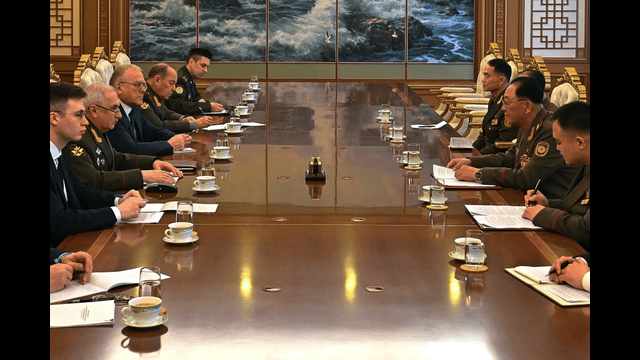
In this photo provided by North Korean government, Russian Vice Defense Minister Viktor Goremykin, second left, meets North Korean Defense Minister No Kwang Chol, second right, at an undisclosed place in North Korea Thursday, Nov. 6, 2025. Independent journalists were not given access to cover the event depicted in this image distributed by the North Korean government. The content of this image is as provided and cannot be independently verified.
North Korea and Russia appear to be tightening their military alliance, with top officials from both nations meeting in Pyongyang this week to discuss expanded cooperation. The talks signal deepening ties between the two countries as Moscow continues its war in Ukraine and faces mounting international sanctions.
Pyongyang and Moscow Strengthen Military Partnership
According to North Korea’s state-run Korean Central News Agency (KCNA), senior military officials from both sides met on Wednesday to explore ways to enhance collaboration. The North Korean delegation was led by Pak Yong Il, vice director of the Korean People’s Army’s General Political Bureau, while the Russian side was represented by Vice Defense Minister Viktor Goremykin.
KCNA reported that the discussions focused on boosting cooperation based on the “deepened bilateral relations” fostered by Kim Jong Un and Vladimir Putin. The agency did not reveal any formal agreements or details of specific initiatives.
Goremykin also held separate talks with North Korean Defense Minister No Kwang Chol on Thursday, further underlining the two nations’ ongoing military engagement.
Seoul Raises Concerns Over Possible Troop Movement
The meetings come as South Korea’s National Intelligence Service (NIS) warned lawmakers that it had observed possible recruitment and training activities in North Korea. These moves, the agency said, could signal preparations for additional troop deployments to Russia.
During a press briefing, Chang Yoon-jeong, spokesperson for South Korea’s Unification Ministry, said the government was closely monitoring the situation but refrained from making assumptions about the purpose of these activities.
South Korean intelligence assessments estimate that around 15,000 North Korean troops have already been sent to Russia since last fall. These deployments reportedly support Moscow’s military operations in Ukraine and include the supply of artillery, ballistic missiles, and other equipment.
Construction Troops Sent to Russia’s Kursk Region
The NIS also reported that 5,000 North Korean military construction workers have been gradually dispatched to Russia since September. These troops are believed to be working on infrastructure restoration projects, particularly in Russia’s Kursk region, which has faced heavy damage during the ongoing conflict.
Additionally, Kim Jong Un has reportedly agreed to send thousands of deminers and construction workers to assist Russian rebuilding efforts—moves that analysts view as part of Pyongyang’s broader strategy to strengthen ties with Moscow in exchange for economic and technological support.
U.S. and Allies Respond to Growing Threat
The growing military cooperation between North Korea and Russia has alarmed both the United States and its allies. Earlier this week, U.S. Defense Secretary Pete Hegseth visited Seoul for annual security talks and praised South Korea’s plan to increase defense spending amid growing regional threats.
Washington has repeatedly accused North Korea of supplying arms and ammunition to Russia in violation of United Nations Security Council sanctions. Both Pyongyang and Moscow have denied these allegations, insisting that their cooperation is lawful and defensive in nature.
Strategic Alliance Deepens Amid Global Tensions
Experts believe the North Korea-Russia partnership represents a new phase of military alignment driven by mutual isolation. Moscow, under pressure from Western sanctions, sees Pyongyang as a willing partner that can supply manpower and munitions. Meanwhile, North Korea gains economic leverage and potential access to Russian technology and energy resources.
The renewed cooperation could shift the strategic balance in Northeast Asia and complicate efforts by the U.S. and its allies to curb North Korea’s nuclear ambitions. As the war in Ukraine continues, observers warn that Pyongyang’s growing involvement could further escalate tensions in the region.