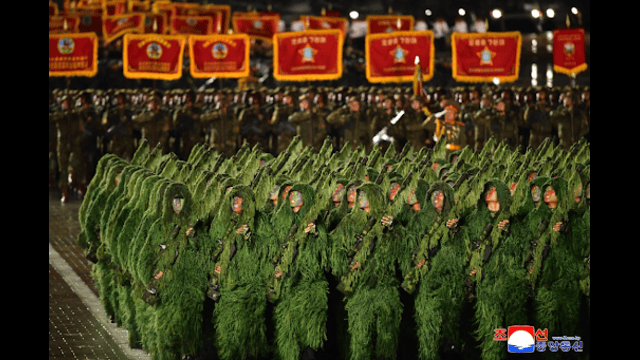
In this photo provided by the North Korean government, soldiers march during the military parade marking the 80th anniversary of the founding of the ruling Workers’ Party, in Pyongyang, North Korea, Friday, Oct. 10, 2025. Independent journalists were not given access to cover the event depicted in this image distributed by the North Korean government. The content of this image is as provided and cannot be independently verified. Korean language watermark on image as provided by source reads: “KCNA,” which is the abbreviation for the Korean Central News Agency.
Senior North Korean and Russian military officials have held new talks in Pyongyang to strengthen defense cooperation. The meeting marks another step in the two nations’ growing military alliance as Russia continues its war in Ukraine.
High-Level Talks Signal Expanding Partnership
North Korea’s state-run Korean Central News Agency (KCNA) confirmed that the meeting took place on Wednesday. The North Korean delegation was led by Pak Yong Il, vice director of the Korean People’s Army’s General Political Bureau. The Russian side was headed by Vice Defense Minister Viktor Goremykin.
According to KCNA, both sides discussed ways to boost military collaboration under the “deepened bilateral relations” between Kim Jong Un and Vladimir Putin. The agency did not disclose specific agreements or commitments made during the talks.
A day later, Goremykin’s delegation also met with North Korean Defense Minister No Kwang Chol, signaling ongoing coordination between the two countries’ defense departments.
South Korea Monitors Possible Troop Deployment
The renewed military dialogue follows reports from South Korea’s intelligence agency suggesting possible North Korean troop movements toward Russia.
In a closed-door briefing, South Korea’s National Intelligence Service (NIS) told lawmakers it had detected recruitment and training activities in North Korea. These activities could indicate preparations for additional troop deployments to Russia.
When questioned about this, South Korea’s Unification Ministry said it was closely watching developments but refrained from drawing conclusions.
Growing Military Support for Russia
Seoul’s intelligence assessments estimate that North Korea has already sent around 15,000 troops to Russia since late last year. Pyongyang is also believed to have supplied Moscow with large quantities of military equipment, including artillery and ballistic missiles, to support its war against Ukraine.
North Korean leader Kim Jong Un has reportedly agreed to send more personnel, including construction workers and deminers, to assist with reconstruction in Russia’s Kursk region.
The NIS briefing also revealed that about 5,000 North Korean military construction troops have been gradually deployed to Russia since September. Their role is believed to involve participation in infrastructure restoration projects.
Strategic Timing Amid Regional Uncertainty
The Pyongyang meetings coincided with U.S. Defense Secretary Pete Hegseth’s visit to Seoul for annual security consultations with South Korean officials. During the visit, Hegseth praised South Korea’s decision to increase its defense budget amid growing threats from nuclear-armed North Korea and wider regional instability.
Analysts suggest the timing of the North Korea–Russia discussions may be deliberate. As Western alliances strengthen in East Asia, Pyongyang and Moscow appear to be tightening their own military ties in response.
A Deepening Alliance with Global Implications
The intensifying cooperation between North Korea and Russia reflects a shifting balance in global power dynamics. Both nations face heavy international sanctions and diplomatic isolation, which has driven them closer together.
Military experts warn that the partnership could reshape security risks in both Europe and the Asia-Pacific region. North Korea’s growing involvement in Russia’s war effort not only boosts Moscow’s military capacity but also raises fresh concerns for global stability.
As the two countries continue to coordinate military and political strategies, observers say the coming months could see an even stronger North Korea–Russia defense alignment — a development watched closely by Seoul, Washington, and other world powers.