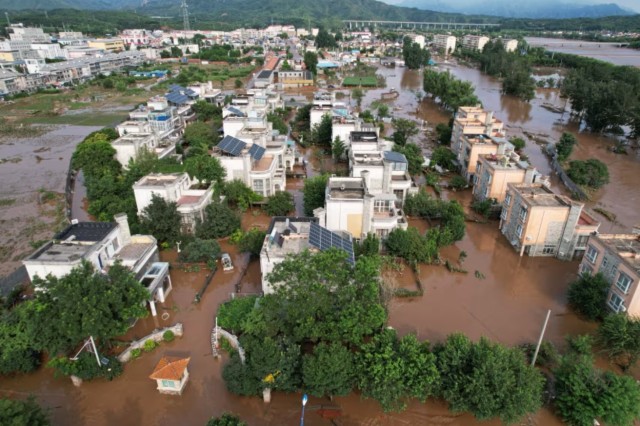
An aerial view shows submerged residential buildings after heavy rains at Taishitun village in Miyun district, in northern Beijing, on July 28, 2025.
Torrential rain has battered northern Beijing, leaving devastation in its wake. At least 30 lives have been lost in what has become one of the deadliest flooding events in recent years. What started as heavy downpours turned into a disaster that swept away homes, vehicles, and infrastructure, paralyzing daily life and testing the government’s emergency response.
Record Rainfall Turns Beijing Streets Into Rivers
Over the past few days, intense rainstorms have lashed northern China, including Beijing’s outskirts. The worst-hit area was Miyun, a mountainous district in northeastern Beijing. Here, 28 people lost their lives as torrential floods swept through communities. Two more fatalities were reported in Yanqing, another district to the north of the capital.
Residents witnessed streets turning into raging rivers. Social media was flooded with images and videos showing brown water carrying cars, tree trunks, and debris. Roads crumbled, and power lines collapsed. Over 80,000 people have been evacuated, with around 17,000 from Miyun alone, according to state broadcaster CCTV.
Fear and Despair Gripped Residents
A woman from a small town in Miyun shared her terrifying experience online. “The river near us burst its banks. Trees, vehicles, and debris rushed by all night. I never imagined my hometown in Beijing could face such destruction,” she wrote on Xiaohongshu, China’s version of Instagram.
Many villages were left without electricity or communication. Rescue teams, including firefighters and telecom workers, struggled to reach isolated communities. Boats and excavators were used to evacuate those trapped. In one act of bravery, a local man used his boat to save 17 people. Another used his excavator to rescue over 80 residents.
Floodwater Discharge Amid Record Highs
To manage the rising waters, authorities discharged floodwater from the Miyun Reservoir. Reports say the peak flood flow reached 6,550 cubic meters per second — the highest ever recorded. Beijing received an average of 166 mm of rainfall in just a few days, nearly matching the city’s monthly average. In Miyun, rainfall reached a staggering 543 mm — close to Beijing’s yearly total.
In response, the city issued its highest-level flood alert, warning residents to avoid rivers and flood-prone areas. A red alert for rainstorms was also declared, highlighting the risk of flash floods, mudslides, and landslides, especially in hilly terrain.
City Shutdown and Safety Measures
Authorities swiftly shut down schools, construction sites, rural homestays, and scenic locations. All outdoor tourism activities were canceled. By Tuesday afternoon, rains began to subside in central Beijing, offering slight relief. However, the damage was already done.
Chinese President Xi Jinping called the situation “extremely serious” and ordered all-out efforts for rescue and recovery. He urged officials to ensure timely evacuations and minimize further casualties. Xi emphasized the need for improved preparedness in the face of increasing climate-related disasters.

A villager's house is covered with mud at Liulimiao Town in Huairou District, Beijing, on July 28, 2025.
International Support and Reminders of Past Tragedies
David Perdue, the newly appointed U.S. ambassador to China, expressed condolences. “We are deeply saddened by the loss of life due to the flooding in Beijing and other regions. Our thoughts are with the families of the victims,” he said on platform X.
This disaster comes just two years after Beijing faced another deadly flood that killed 33 people. In 2023, the city endured its heaviest rainfall in 140 years, sparking severe flash floods in its western mountains.
Northern Provinces Also Hit Hard
The flooding extended beyond Beijing. In Hebei province, four people died in a landslide, and eight remain missing. In Shanxi, a bus carrying 14 passengers went missing after being swept away. One body was recovered, and searches continue.
In Shandong, flash floods destroyed 19 homes after five hours of intense rainfall equaling half a year’s average. Two people died, and ten remain unaccounted for.
Residents in mountainous regions like Yangjiatai village in Chengde, Hebei, pleaded for help online. A woman shared how her village was struck by landslides, cutting off all access and communication. “Only a few managed to make it out to bring in supplies. Most villagers remain stranded,” she said.
As climate change intensifies, extreme weather is becoming the new norm for China. The recent Beijing floods have once again highlighted the urgent need for disaster-resilient infrastructure, early-warning systems, and robust emergency response mechanisms.