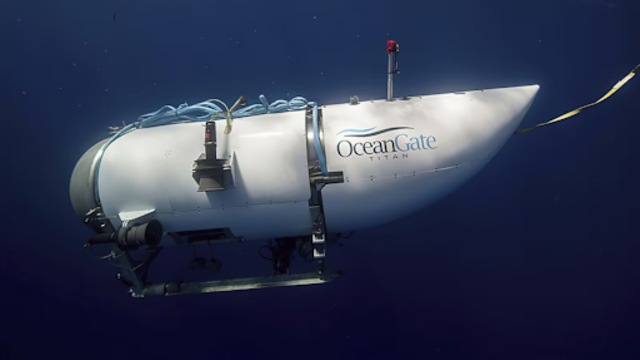
This image, shared by OceanGate Expeditions, shows the Titan submersible, which was used for deep-sea trips to explore the Titanic wreck. AP Photo
A new report has confirmed that faulty engineering caused the Titan submersible to implode during its dive to the wreck of the Titanic, killing all five people on board.
The National Transportation Safety Board (NTSB) released its final findings Wednesday, nearly two years after the tragedy in June 2023. Investigators concluded that the Titan’s carbon fibre hull was poorly designed and did not meet the strength and safety standards needed to survive the extreme pressure of the deep ocean.
The report stated that the “construction of the carbon fiber composite pressure vessel contained multiple anomalies and failed to meet necessary strength and durability requirements.”
The Titan imploded during its descent in the North Atlantic, roughly 700 kilometres south of St. John’s, Newfoundland, killing everyone instantly.
OceanGate Ignored Safety Protocols
Investigators said OceanGate, the company that built and operated the Titan, did not properly test the submersible before its missions. The report also revealed that OceanGate’s team had an inaccurate understanding of the vessel’s actual strength.
The NTSB noted that if OceanGate had followed standard emergency procedures, search crews could have found the wreckage sooner. Though the implosion was not survivable, investigators said that following protocol would have “saved time and resources.”
A Canadian Coast Guard ship later recovered debris from the ocean floor and brought it to St. John’s in late June 2023.
Preventable Tragedy
The NTSB’s findings align with an earlier report by the U.S. Coast Guard, which called the implosion “preventable.” The Coast Guard described OceanGate’s safety practices as “critically flawed,” pointing to major gaps between what was required and what was actually done.
OceanGate suspended its operations in July 2023 and has since shut down. A company spokesperson declined to comment on the latest report.
Remembering the Victims
The disaster claimed the lives of five men, including OceanGate CEO Stockton Rush, who piloted the sub. Others on board included French explorer Paul-Henri Nargeolet, British adventurer Hamish Harding, and Pakistani businessman Shahzada Dawood along with his 19-year-old son Suleman.
Their deaths sparked global mourning and renewed calls for stronger oversight of private deep-sea expeditions.
Recommendations for the Future
The NTSB urged the U.S. Coast Guard to form a panel of experts to study submersible design and safety. The agency also recommended new regulations for private underwater vessels based on the panel’s findings.
Current safety rules for small passenger crafts, the report said, allowed OceanGate to operate the Titan “in an unsafe manner.” The NTSB also suggested that future safety findings be shared across the industry as more companies enter the deep-sea tourism sector.
The report included testimony from a former OceanGate employee who said the company’s culture ignored warnings about safety and regulations. The employee recalled Rush saying that if the Coast Guard interfered, “he would buy himself a congressman and make it go away.”
Final Moments
The Titan began its final dive on June 18, 2023, aiming to explore the Titanic wreck nearly 4,000 metres below sea level. About two hours into the descent, the sub lost contact with its support ship. Rescue teams from several countries searched the area for days. Eventually, officials confirmed that the vessel had imploded, ending hopes of survival.