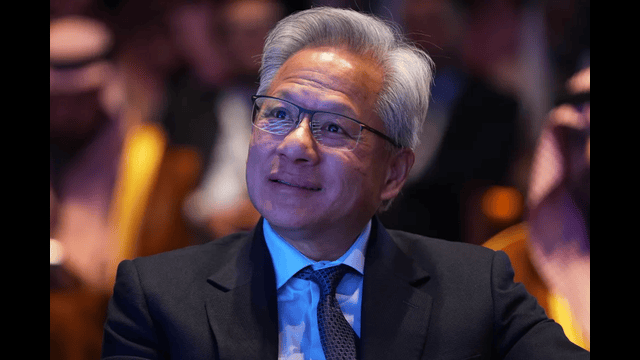
Nvidia CEO Jensen Huang listens as President Donald Trump speaks during the Saudi Investment Forum at the Kennedy Center, Wednesday, Nov. 19, 2025, in Washington.
Nvidia CEO Jensen Huang visited Capitol Hill on Wednesday for private meetings with President Donald Trump and Republican senators. His visit came during a critical moment in the global AI race, where U.S. lawmakers, tech giants, and security officials remain sharply divided over how to regulate artificial intelligence and the export of high-end chips to China.
Huang’s Push for Fewer Restrictions
Huang met with Republicans on the Senate Banking Committee to discuss Nvidia’s position on AI policy and export controls. The conversations reflected the rising pressure on U.S. tech leaders lobbying for favorable rules as investments in AI surge worldwide.
Huang warned that overly strict restrictions could stall innovation. He argued that the U.S. must maintain leadership in advanced computing by ensuring American companies remain competitive.
“We support export controls,” Huang said before his meeting. “But American companies need the best, the most, and first.”
He acknowledged concerns about selling AI chips to China but noted that restrictions have not slowed China’s progress in the AI race.
The China Question: A Central Flashpoint
The debate over whether Nvidia should sell AI chips to China remains one of Washington’s most contentious technology issues. The U.S. sees China as its primary competitor in developing advanced AI systems, including artificial superintelligence.
Huang insisted that degraded or weakened chips would not be accepted by Chinese buyers. He argued the U.S. must compete with “the most competitive chips we can offer.”
His remarks drew immediate attention, especially as the Trump administration recently reversed Biden-era limits on exporting advanced chips. An unusual August agreement also allows Nvidia and AMD to sell chips in China, with 15% of the revenue going to the U.S. government.
The deal has deeply divided Congress.
Trump Meeting and Industry Strategy
Huang confirmed he met with President Trump earlier in the day to discuss Nvidia’s export concerns. He described the meeting as cordial and wished the president “happy holidays.”
The CEO’s visit reflects a broader push by Silicon Valley leaders seeking clarity and stability in AI rules as the technology rapidly evolves.
Divisions on Capitol Hill
Lawmakers from both parties have expressed concerns about national security risks tied to exporting cutting-edge AI chips. Several AI-related bills have been proposed this year, though none have become law.
Republican senators who attended the meeting called it productive.
Sen. Mike Rounds said the discussion was “healthy” and that policymakers remained “open to a wide range of policies.”
When asked whether Nvidia’s goals aligned with U.S. national security, Rounds responded:
“They understand they’re an American company. They want to compete globally. They hope to compete in China again someday but recognize export controls matter.”
Not all Republicans were receptive.
Sen. John Kennedy openly dismissed Huang’s credibility:
“He’s got more money than the Father, the Son and the Holy Ghost… but he’s not who I’d ask for objective advice.”
Democrats Criticize the Closed-Door Meeting
Democrats were not invited to Huang’s meeting and did not hide their frustration.
Sen. Elizabeth Warren criticized the lack of transparency and called for Huang to testify publicly.
“He wants to lobby Republicans in secret rather than explain himself,” Warren said.
She added that Nvidia must answer why it “wants to favor Chinese manufacturers over American companies that need high-quality chips.”
Growing Pressure as the AI Race Escalates
Huang’s Capitol Hill discussions highlight the intensifying political battle over America’s role in the AI race. Policymakers must balance innovation, national security, economic competitiveness, and global diplomacy—all while AI advances faster than regulations can keep up.
As Nvidia maintains its position at the center of the world’s AI infrastructure, the debate over its role in China—and U.S. export policy—shows no signs of slowing.