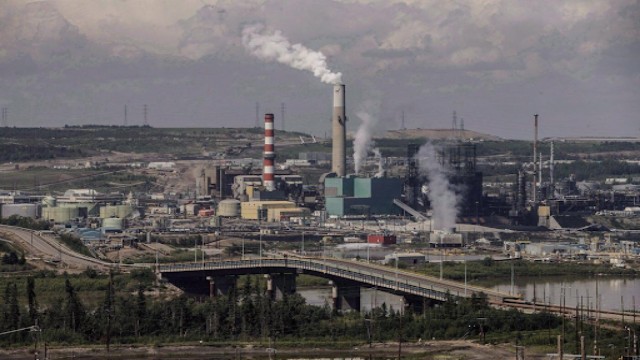
Suncor’s main facility, including its oil upgrading units, is located in the oilsands region of Fort McMurray, Alberta, (Photo: THE CANADIAN PRESS/Jason Franson)
Canada’s Oilsands Gears Up for Major Growth
S&P Global Commodity Insights has released a fresh report forecasting a record-breaking year for Canada’s oilsands, with output expected to rise significantly even as global oil prices remain shaky. This marks the fourth time in a row that S&P has raised its long-term outlook for the oilsands, highlighting the sector’s ability to push forward despite market instability.
Production Growth on Track
According to the report, Canadian oilsands production is on pace to hit 3.5 million barrels per day in 2025, up from previous forecasts. Even more impressively, output is expected to climb to over 3.9 million barrels per day by 2030. That’s a notable three per cent increase from S&P’s earlier 10-year projection. By 2035, production may level out around 3.7 million barrels daily, still 100,000 barrels more than earlier predictions.
Smarter, Not Bigger: A New Growth Strategy
Unlike the massive, costly oilsands projects of the past, today’s production boost is driven by smarter, more efficient use of existing operations. According to Kevin Birn, S&P’s chief Canadian oil analyst, companies are focusing on streamlining production—by reducing delays, boosting throughput, and fixing bottlenecks—rather than launching new mega-projects.
Price Volatility and Profit Margins
Despite recent turmoil in the global oil market, Canadian oilsands producers remain largely unfazed. Oil prices briefly surged due to tensions between Israel and Iran but dropped sharply after a temporary ceasefire was announced by the U.S. President. The price dipped to US$64.37 a barrel on Tuesday.
However, S&P says that even at this price, oilsands operations remain solid. The average break-even point for these companies is just US$27 a barrel, far below previous decades. This low threshold gives producers room to continue investing in efficiency upgrades, regardless of short-term market drops.
Challenges Still Linger
While the outlook is optimistic, there are some hurdles. Celina Hwang, S&P’s director of crude oil markets, points out that export pipeline constraints could limit growth. The Trans Mountain pipeline expansion, now operational, is currently the only major route connecting Canadian oil to overseas markets beyond the U.S. No new private-sector projects are currently proposed.
Despite potential export limitations and market unpredictability in 2025, Hwang remains confident in the oilsands’ resilience. The sector has previously withstood severe price shocks, and its low-cost operations remain a key strength.
What It Means for the Canadian Economy
A separate report from RBC economists suggests that rising oil prices may have little effect on Canada’s overall economy. While higher crude prices increase gasoline costs and hit household budgets, they also drive up revenues for oil-producing provinces. Since the oil and gas industry accounts for 7% of Canada’s GDP, these price gains bring in strong profits and higher government royalties.
Still, RBC’s Nathan Janzen and Claire Fan argue that if oil prices rise to US$75 per barrel and hold steady, the impact on inflation would be modest—raising the consumer price index by just 0.4% above their current forecast.
They also suggest that short-term price hikes tied to geopolitics aren’t enough to revive the kind of big-budget oilsands investments that have largely faded over the last decade.