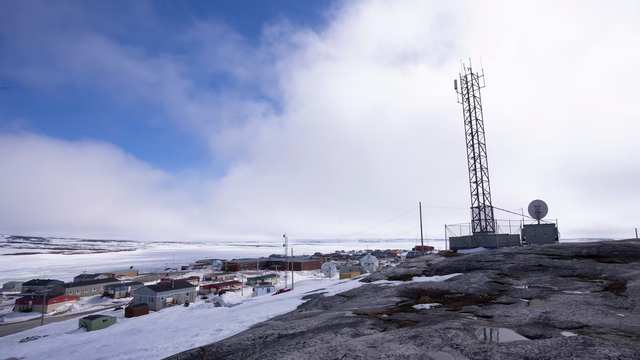
A telecom tower stands in Inukjuak, a village by Hudson Bay in Quebec, as seen on Thursday, May 12, 2022. The Canadian Press
In a remote part of northeastern Quebec, near the Inuit village of Inukjuak, scientists have found some of Earth’s oldest known rocks. These ancient volcanic rocks lie along the eastern shore of Hudson Bay in an area called the Nuvvuagittuq Greenstone Belt. They appear dark and light green, with specks of pink and black.
Rocks from Earth’s Earliest Days
Recent tests show these rocks are about 4.16 billion years old. That places them in the Hadean eon, a time when Earth was still forming and conditions were harsh. The Hadean got its name from the Greek god of the underworld, Hades.
The rocks, which were once molten magma, cooled and hardened beneath the surface. Over time, pressure and heat turned them into metamorphosed volcanic rocks, mainly basalt.
How the Age Was Found
Scientists used two dating techniques. Both focused on how elements like samarium and neodymium break down over time. These methods confirmed the rocks’ age. Since both tests gave the same result, researchers are confident in their findings.
Why This Matters
The study’s lead author, Jonathan O’Neil, a geology professor at the University of Ottawa, said these rocks give scientists a rare look at the earliest crust on Earth. Because there are almost no remains from that period, these rocks offer an important clue about how Earth began to form.
O’Neil believes the rocks may have formed when rain fell on molten lava, cooling it down. That rain came from water that had evaporated from Earth’s early oceans.
Some parts of the rock even seem to have formed from minerals that settled out of seawater. Studying them could reveal what early oceans were like and help scientists understand where life may have started on Earth.
Older Than Previously Known Rocks
Until now, the oldest known rocks were from Canada’s Northwest Territories and were about 4.03 billion years old. Although small zircon crystals found in Australia date back even further (about 4.4 billion years), they are not considered full rock formations.
A New Look at the Hadean Eon
Many believed the early Earth was completely molten. But this discovery shows that by 4.4 billion years ago, Earth had already developed a solid crust, warm oceans, and an atmosphere—though it was quite different from today’s.
Clearing Up Past Confusion
There had been debate about the age of the Nuvvuagittuq rocks. A 2008 study gave mixed results, suggesting dates between 3.3 and 4.3 billion years. The newer tests are more reliable and place the intrusion rocks at 4.16 billion years old, meaning the surrounding volcanic rocks are likely even older—about 4.3 billion years.